

Cubic Yard Calculator
Estimate volume, weight, overage, bags, truckloads, and cost for common landscaping and construction materials.
People used this calculator
Your current platform: —
Global counter (server-side).
Cubic Yard Calculator: Convert Measurements Into Cubic Yards
What This Cubic Yard Calculator Does
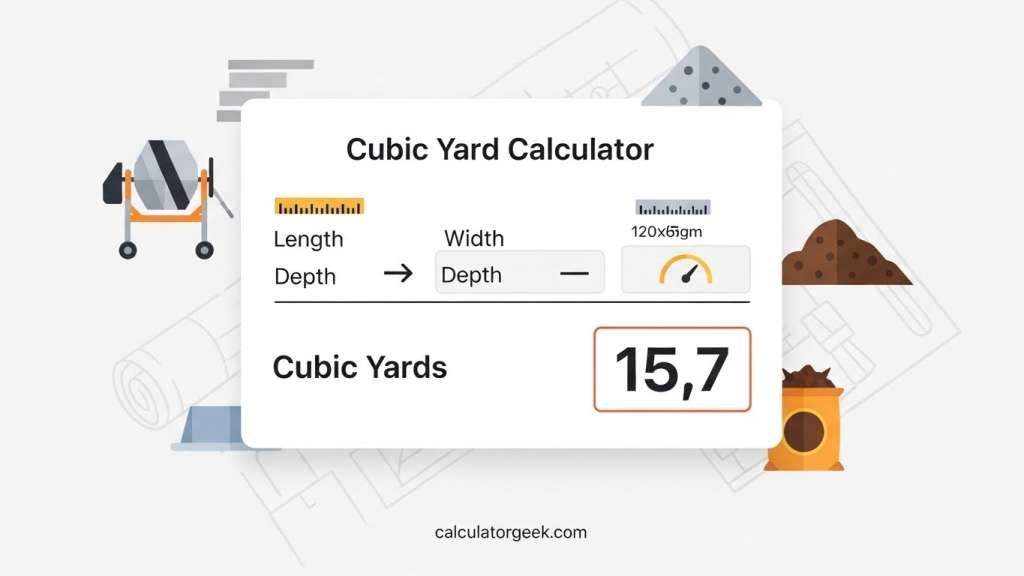
The Cubic Yard Calculator helps you calculate how many cubic yards of mulch, gravel, topsoil, sand, concrete, compost, rock, or fill dirt you need for a project. Enter your dimensions, choose the correct shape, and the calculator converts the volume into cubic yards, the unit most suppliers use for bulk material orders.
Best For
- mulch beds and tree rings
- gravel paths and driveway base
- topsoil, compost, and raised beds
- concrete slabs and footings
- post holes, circular areas, and tapered sections
Quick Formula
Cubic yards = cubic feet ÷ 27
If you already know area in square feet and depth in inches:
Cubic yards = (square feet × depth in inches) ÷ 324
Results Are Estimates
Material needs can vary because of compaction, settling, moisture, grading differences, and supplier rounding rules. For most projects, it is smart to order a small overage.
What Is a Cubic Yard?
A cubic yard is a unit of volume equal to a space measuring 3 feet × 3 feet × 3 feet. That means:
- 1 cubic yard = 27 cubic feet
- 1 cubic yard ≈ 0.765 cubic meters
Bulk materials such as mulch, gravel, topsoil, sand, compost, rock, and concrete are commonly sold by the cubic yard. That is why a cubic yard calculator is so useful for landscaping, gardening, and construction planning.
How to Calculate Cubic Yards
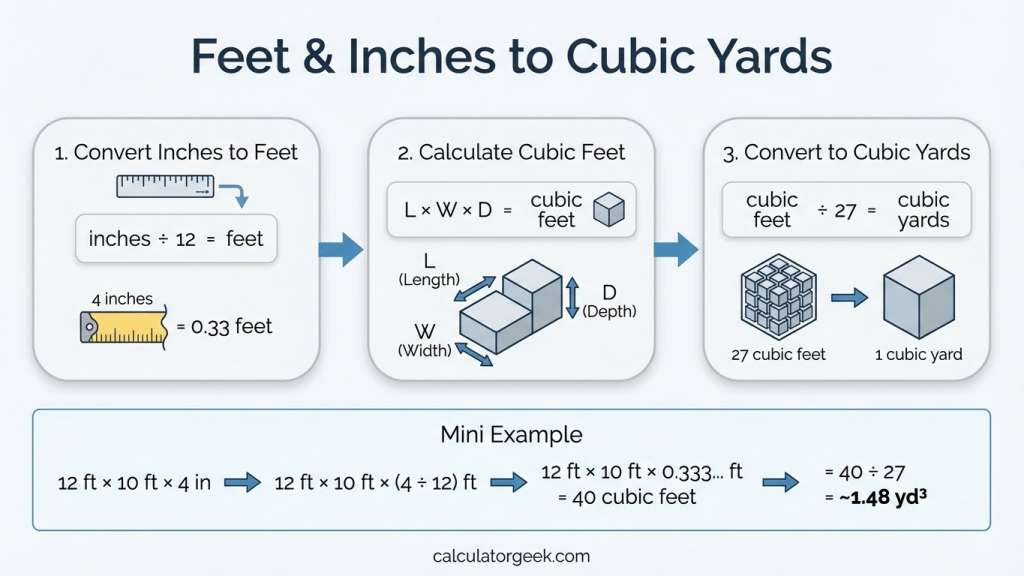
To calculate cubic yards manually:
- Measure the length, width, and depth
- Convert all measurements into the same unit
- Calculate the total volume
- Divide by 27 to convert cubic feet into cubic yards
Cubic Yard Formula for Rectangles
Cubic yards = (length × width × depth) ÷ 27
If the depth is in inches, convert it to feet first:
Depth in feet = depth in inches ÷ 12
Shortcut Formula Using Square Feet
If you already know the area in square feet and the depth in inches, use:
Cubic yards = (square feet × depth in inches) ÷ 324
This shortcut is ideal for mulch, gravel, topsoil, compost, and other spread materials.
Example: How to Calculate Cubic Yards for a Slab
Suppose you need concrete for a slab that is:
- 12 feet long
- 10 feet wide
- 4 inches deep
Step 1: Convert depth to feet
4 ÷ 12 = 0.333 feet
Step 2: Calculate cubic feet
12 × 10 × 0.333 = 39.96 cubic feet
Step 3: Convert cubic feet to cubic yards
39.96 ÷ 27 = 1.48 cubic yards
For real-world ordering, many people round up slightly and add a small buffer.
Metric and Imperial Conversion Guide
Because users often measure projects in different units, this calculator supports both imperial and metric inputs.
Common Length Conversions
- 1 foot = 12 inches
- 1 yard = 3 feet
- 1 foot = 0.3048 meters
- 1 yard = 0.9144 meters
- 1 meter = 3.28084 feet
- 1 centimeter = 0.3937 inches
Common Volume Conversions
- 1 cubic yard = 27 cubic feet
- 1 cubic yard ≈ 0.765 cubic meters
- 1 cubic meter ≈ 1.308 cubic yards
This makes it easier to switch between feet, inches, yards, centimeters, and meters when estimating volume.
Cubic Yard Coverage Chart
Coverage per 1 Cubic Yard by Depth
| Depth | Coverage |
|---|---|
| 1 inch | 324 sq ft |
| 2 inches | 162 sq ft |
| 3 inches | 108 sq ft |
| 4 inches | 81 sq ft |
| 6 inches | 54 sq ft |
| 12 inches | 27 sq ft |
Quick Formula
Coverage in square feet = 324 ÷ depth in inches
This chart is especially useful for users searching for a cubic yard coverage chart, mulch coverage per yard, or gravel coverage per cubic yard.
Square Feet to Cubic Yards Table
| Area | 2″ deep | 3″ deep | 4″ deep |
|---|---|---|---|
| 100 sq ft | 0.62 yd³ | 0.93 yd³ | 1.23 yd³ |
| 200 sq ft | 1.23 yd³ | 1.85 yd³ | 2.47 yd³ |
| 300 sq ft | 1.85 yd³ | 2.78 yd³ | 3.70 yd³ |
| 500 sq ft | 3.09 yd³ | 4.63 yd³ | 6.17 yd³ |
| 1000 sq ft | 6.17 yd³ | 9.26 yd³ | 12.35 yd³ |
Formula: yd³ = (sq ft × inches) ÷ 324
Related Calculators: Square Footage Calculator
Bags Per Cubic Yard
If you are using bagged material instead of bulk delivery, this table helps convert cubic yards into bag counts.
| Bag Size | Bags per Cubic Yard |
|---|---|
| 0.5 cu ft | 54 |
| 0.75 cu ft | 36 |
| 1.0 cu ft | 27 |
| 1.5 cu ft | 18 |
| 2.0 cu ft | 13.5 |
| 3.0 cu ft | 9 |
Formula
Bags per cubic yard = 27 ÷ bag size in cubic feet
Recommended Material Depths
| Use Case | Typical Depth |
|---|---|
| Mulch beds | 2–4 inches |
| Tree rings | 2–3 inches |
| Playground mulch | 8–12 inches |
| Gravel path | 3–4 inches |
| Gravel base under pavers | 4–6 inches |
| Lawn topdressing | 0.25–0.5 inch |
| Raised bed soil | 6–12+ inches |
| Compost amendment | 1–3 inches |
These ranges help users decide how deep to spread a material before calculating cubic yards.
Material Weight Estimates Per Cubic Yard
Approximate weight matters because volume and weight are not the same. A pickup truck may have enough space for a load but not enough payload capacity.
| Material | Approximate Weight per Cubic Yard |
|---|---|
| Concrete | about 4,000 lb |
| Gravel | about 2,800 lb |
| Sand | about 2,700–3,000 lb |
| Topsoil | about 1,200–1,300 lb |
| Compost | about 1,000–1,100 lb |
| Mulch | much lighter, varies widely |
Why weight varies
Actual weight changes based on:
supplier mix
moisture content
compaction
material type
particle size
Related Calculators: Asphalt Calculator
How Many Wheelbarrows Are in a Cubic Yard?
A cubic yard equals 27 cubic feet, so the number of wheelbarrow loads depends on wheelbarrow size.
- Small wheelbarrow: about 13–14 loads
- Medium wheelbarrow: about 6 loads
- Large construction wheelbarrow: about 5 loads
This is useful for DIY landscaping and garden planning.
How Many Cubic Yards Fit in a Pickup Truck?
This depends on both bed volume and payload capacity.
- Light mulch can often take up more space before weight becomes a problem
- Gravel, sand, topsoil, and concrete are much heavier
- Many trucks hit their safe weight limit before the bed is full
That means the correct answer is usually: check payload first, not just bed size
Compaction, Moisture, Settling, and Waste
Even a correct cubic yard calculation can differ from what you actually need on-site.
Common reasons real-world yardage changes
- compaction after spreading
- settling over time
- moisture changes
- uneven ground
- spillage during transport or installation
- supplier rounding practices
Suggested Overage Guide
| Project Type | Extra to Add |
|---|---|
| Decorative mulch | 5–10% |
| Gravel paths | 10–15% |
| Stone base under pavers | 10–15% |
| Topsoil grading | 5–10% |
| Concrete | around 5% |
| Playground mulch | 10–20% |
Caution
Do not order exact yardage with no buffer unless your project is highly controlled and measured very precisely.
Methodology
This Cubic Yard Calculator follows a simple process:
- Determine the correct shape
- Measure the required dimensions
- Convert all values into a consistent base unit
- Calculate volume using the proper geometric formula
- Convert cubic feet to cubic yards by dividing by 27
- Present estimated results for planning and ordering
This tool estimates volume only. It does not evaluate structural strength, compaction test results, engineering design requirements, or supplier-specific delivery rules.
Cubic Yards Formulas by Shape
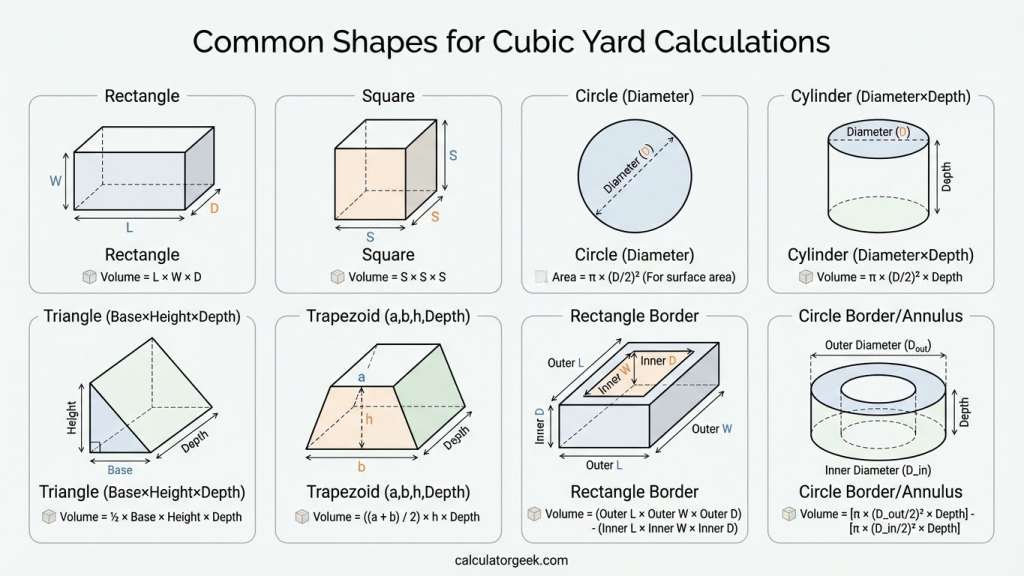
Square
- Area (ft²) = Side × Side
- Volume (ft³) = Depth × Area
- Volume (yd³) = Volume (ft³) ÷ 27
Rectangle
- Area (ft²) = Length × Width
- Volume (ft³) = Depth × Area
- Volume (yd³) = Volume (ft³) ÷ 27
Rectangle Border
- Inner Area (ft²) = Length × Width
- Total Area (ft²) = [Length + (2 × Border Width)] × [Width + (2 × Border Width)]
- Border Area (ft²) = Total Area − Inner Area
- Volume (yd³) = (Depth × Border Area) ÷ 27
Circle
- Area (ft²) = π × (Diameter ÷ 2)²
- Volume (yd³) = (Depth × Area) ÷ 27
- Use π ≈ 3.14.
Circle Border (Annulus)
- Outer Diameter = Inner Diameter + (2 × Border Width)
- Area (ft²) = π × (Outer Diameter ÷ 2)² − π × (Inner Diameter ÷ 2)²
- Volume (yd³) = (Depth × Area) ÷ 27
Triangle
- Area (ft²) = 1/2 × Base × Height
- Volume (yd³) = (Depth × Area) ÷ 27
Trapezoid
- Area (ft²) = ((a + b) ÷ 2) × h
- Volume (yd³) = (Depth × Area) ÷ 27
Common Mistakes When Using a Cubic Yard Calculator
Mixing inches and feet
If depth is entered in inches while length and width are in feet, the result will be wrong unless depth is converted properly.
Forgetting depth
Square footage alone is not enough. Cubic yard calculations always require depth.
Using only one depth measurement
Uneven areas should be measured in multiple places and averaged.
Ignoring compaction and settling
Loose material may not occupy the same final volume after installation.
Forgetting weight limits
Truck bed volume does not automatically mean the truck can safely carry that load.
Limitations and Disclaimer
This calculator provides estimates for planning and ordering. Actual material requirements may vary because of compaction, settling, surface irregularities, delivery conditions, and supplier rounding. For structural concrete, engineered fill, foundations, load-bearing surfaces, or code-sensitive projects, confirm requirements with a qualified contractor, engineer, or supplier.
FAQs
How do I calculate cubic yards?
Multiply length × width × depth to get cubic feet, then divide by 27.
How many cubic feet are in a cubic yard?
There are 27 cubic feet in 1 cubic yard.
How much does 1 cubic yard cover?
At 1 inch deep, about 324 square feet. At 3 inches deep, about 108 square feet. At 4 inches deep, about 81 square feet.
How many wheelbarrows are in a cubic yard?
Usually about 5 to 14 wheelbarrow loads, depending on wheelbarrow size.
How many bags of mulch equal one cubic yard?
One cubic yard equals 27 cubic feet, so it takes:
- 13.5 bags of 2 cu ft
- 9 bags of 3 cu ft
How many cubic yards fit in a pickup truck?
It depends on the truck’s payload rating and the material weight. Light mulch fits more safely than gravel or sand.
How much does a cubic yard of gravel weigh?
About 2,800 pounds as a planning estimate, though actual weight varies.
How much does a cubic yard of topsoil weigh?
Roughly 1,200 to 1,300 pounds, depending on moisture and composition.
How much does a cubic yard of concrete weigh?
Around 4,000 pounds.
Is this calculator good for mulch, gravel, topsoil, sand, and concrete?
Yes. The volume formula is the same, but depth, weight, compaction, and overage differ by material.
Author
Author: CalculatorGeek Editorial Team
Reviewed by: Zulfiqar Ali, PhD (Civil Engineering)
Expertise: Civil engineering, construction materials, site quantity estimation, and volume planning
Editorial Standards
CalculatorGeek content is written to be:
- mathematically clear
- practical for real-world use
- easy to understand
- updated when improvements are needed
References
Texas A&M AgriLife Extension – How Much Compost, Soil or Mulch?
NIST – General Tables of Units of Measurement