

Body Fat Calculator
Estimate your body fat percentage and fat mass from age, sex, height, and weight. Use BMI-based or U.S. Navy tape formulas.
People used this calculator
Your current platform: —
This total is global for all users (desktop and mobile) using this calculator on calculatorgeek.com.
Intro
A body fat calculator estimates your body fat percentage (the portion of your total weight that comes from fat mass) using simple measurements like waist, neck, hips, height, and weight. It’s a practical way to track body composition changes over time—especially when the scale alone doesn’t tell the full story. Body fat CAlculator keywords
In this guide, you’ll learn how body fat percentage is calculated, which inputs matter most, and what “accuracy” really means for at-home methods. We’ll also cover how to measure correctly, how results differ for men and women, and when a body fat calculator is likely to be off (common edge cases). Body fat CAlculator keywords
If you want a fast estimate, circumference-based methods (like the U.S. Navy method) are usually the most practical starting point. If you need more precision, caliper (skinfold) methods can help—when performed consistently and correctly. Body fat CAlculator keywords
Body Fat Calculator: What It Is and What It Estimates
A body fat calculator estimates your body fat percentage by using anthropometric inputs (your body measurements) to approximate fat mass versus lean mass. It’s best used for consistent tracking over time, not as a perfect “medical-grade” reading.
What “body fat percentage” means (simple definition)
- Body fat percentage = the share of your total body weight that comes from fat tissue.
- The remainder is lean mass (muscle, bone, organs, water, and connective tissue).
Because it separates “weight” into fat mass vs lean mass, body fat percentage can explain why scale weight may stay similar while your shape, strength, or clothing fit changes.
What a body fat calculator can tell you (and what it can’t)
Good for:
- Estimating current body fat percentage in a repeatable way
- Tracking trend direction (up/down) week to week or month to month
- Helping you understand lean body mass changes when you’re dieting or training
Not ideal for:
- Pinpoint accuracy after a single measurement day
- Comparing your number to someone else’s method/device
- Situations where measurement assumptions break (covered in the edge-case section)
Key terms you’ll see in results
| Term | Meaning |
|---|---|
| Fat mass | The amount of your weight that is fat tissue. |
| Lean mass | Everything that isn’t fat (muscle, bone, organs, water). |
| Body composition | The overall breakdown of fat mass vs lean mass. |
| Circumference method | Uses tape measurements (waist/neck/hips) to estimate body fat percentage. |
| Skinfold thickness | Uses calipers to measure fat under the skin at specific sites. |
When a body fat calculator is most useful
Use a body fat calculator when your goal is to answer questions like:
- “Is my body fat trending down while I keep strength?”
- “Did my ‘cut’ reduce fat mass or just water weight?”
- “If my weight is stable, did my body composition still improve?”
A simple rule: one method + same measuring routine + same time of day beats switching methods while chasing a “perfect” number.
Body Fat Percentage: Healthy Ranges and What They Mean
A body fat calculator result is easiest to interpret when you compare it to typical body fat percentage ranges for your sex and activity level. These ranges are guidelines—not diagnoses—and they vary with age, genetics, and training history.
A practical body fat percentage range chart (men vs women)
| Category | Men | Women |
|---|---|---|
| Essential fat | 2–5% | 10–13% |
| Athletes | 6–13% | 14–20% |
| Fitness | 14–17% | 21–24% |
| Average | 18–24% | 25–31% |
| Obese (high body fat) | 25%+ | 32%+ |
How to read this chart
- A “higher” range in women is normal because essential fat needs differ by sex.
- These categories don’t replace clinical assessment. A person’s health risk also depends on fat distribution (e.g., abdominal fat), fitness, blood markers, and medical history.
Why “normal” depends on context (not just a label)
Body fat percentage has to be interpreted alongside the rest of your picture:
- Body shape and waist size: Central (abdominal) fat tends to carry higher metabolic risk than fat stored in hips/thighs.
- Muscle mass: Highly trained people can look “high BMI” but have lower body fat than BMI implies.
- Age: Many people see gradual shifts in body composition with age, even with stable scale weight.
Check your BMI alongside body fat: BMI Calculator
Is My Body Fat Percentage Normal?
For most people, a “normal” body fat percentage is the range that supports good day-to-day health, performance, and sustainability—not the lowest possible number. Use your body fat calculator result as a context check alongside waist size, energy, strength, and how stable your habits feel.
A 60-second “normal” self-check (practical, not perfection)
Use this quick framework:
- Compare your result to a reputable range chart (men vs women categories).
- Check your waist trend (is it stable, rising, or falling over 4–8 weeks?).
- Assess function: sleep, energy, training recovery, mood, and hunger control.
- Confirm consistency: were your measurements taken the same way each time?
If your result lands near a boundary (e.g., “average” vs “fitness”), treat it as a zone, not a hard label.
What “normal” often looks like in real life
- Stable health markers + stable routine: “Normal” is usually the range you can maintain without extremes.
- Performance goals: Some athletes sit lower during a season, then return to a higher, sustainable range.
- Life stage matters: Sleep disruption, stress, and schedule changes can shift body composition even with unchanged weight.
When to pay extra attention (not panic)
These are sensible reasons to re-check measurements or consider professional guidance:
- Your body fat calculator estimate changes a lot week to week (likely measurement variation).
- Your waist increases steadily for 2+ months without an explanation.
- You’re recovering poorly, frequently injured, or chronically fatigued while trying to push body fat very low.
Voice-friendly takeaway
If your measurements are consistent and your result fits a typical range for your sex—and your waist and habits are stable—your body fat percentage is likely “normal enough” for practical purposes.
How to Calculate Body Fat: The Main Methods Compared
You can calculate body fat in a few common ways, but the “best” method depends on whether you need a quick estimate, repeatable trend tracking, or higher precision. Most people do best starting with a body fat calculator that uses tape measurements, then upgrading only if they truly need more detail.
| Method | What it uses | Best for | Main drawbacks |
|---|---|---|---|
| Circumference (U.S. Navy-style) | Tape: waist + neck (+ hips for women), plus height | Fast estimates and consistent tracking | Sensitive to measuring technique; less precise for uncommon body shapes |
| Skinfold calipers | Caliper readings at set body sites | Better detail when done well; good for coaches/athletes | Technique-heavy; inter-tester variation is common |
| BIA scales (bioelectrical impedance) | Electrical impedance + weight | Easy daily trending (same conditions) | Hydration, meals, and exercise can skew results |
| DEXA scan | Clinical scan measuring bone + lean + fat | Higher-precision snapshots; segment detail | Cost/access; not needed for most people’s goals |
| Hydrostatic / air displacement | Density-based lab testing | Research-grade assessments | Special equipment; not convenient for routine tracking |
A simple decision rule (works for most people)
- If you want low effort + reliable trends: use a tape-based body fat calculator weekly.
- If you want more detail and can measure consistently: consider calipers (same tester).
- If you want a baseline snapshot once or twice a year: consider a scan-based method.
Why BMI is not a body fat method (common confusion)
BMI can be useful for population screening, but it does not directly measure body fat and can misclassify muscular or lean individuals. This is why many people prefer a body fat calculator for personal tracking alongside waist measurements and performance markers.
How the Calculatorgeek Body Fat Calculator Works
The Calculatorgeek body fat calculator estimates body fat percentage using one of three selectable methods, so you can balance convenience vs precision based on the inputs you have.
Step 1: Choose sex and calculation method
You start by selecting Female/Male, then pick one method:
- American Diabetes Association (most common)
- U.S. Navy (most precise)
- BMI (least precise)
Each method uses different inputs, which is why your result can change if you switch methods with the same height/weight.
Step 2: Enter the exact inputs the chosen method uses
The calculator accepts multiple units and converts them consistently (cm/m/in/ft, kg/lb).
Inputs available on the page include:
- Sex
- Method (ADA / U.S. Navy / BMI)
- Age (years; or years+months; or years+months+days — converted into a single “years” value)
- Height
- Body weight
- Neck circumference (measured from just under the larynx)
- Waist circumference
- If male: around the navel
- If female: around the narrowest part of the waist
- Hip circumference (around the widest part of the buttock/hip)
Important:
The page explicitly notes that ADA and BMI use a BMI-based equation, while U.S. Navy uses tape measurements (neck/waist/hip) plus height.
Step 3: Read results the right way (what the output includes)
Once you enter your details, the results area provides:
- Estimated body fat (%)
- A body fat category scale (with the marker placed on a 0–40% bar; values above 40% are capped at the right edge)
- Body fat weight (estimated fat mass shown in both kg and lb)
- A “Show formula” option so users can view the formula section directly on the calculator page
A quick “which method should I use?” rule
- Use U.S. Navy if you can measure neck + waist (+ hips for women) carefully. It’s labeled the most precise on the tool.
- Use ADA if you want a common, quick estimate and prefer fewer tape measurements.
- Use BMI method only when you need a rough estimate and don’t have measurement tape—because the tool labels it least precise.
Inputs That Matter Most (And How to Measure Them)
To get a reliable body fat calculator result, measurement technique matters more than tiny day-to-day body changes. If you measure the same way each time, your body fat percentage trend becomes meaningfully trackable.
What matters most (ranked by impact)
- Waist (largest driver for most people)
- Hip (women; changes the estimate noticeably)
- Neck (small errors can swing results more than you expect)
- Height and weight (usually stable, but unit mix-ups are common)
- Age (affects some methods; enter carefully)
Tape measurement rules that prevent “fake changes”
- Use a soft measuring tape (not a belt, not a rigid ruler).
- Measure bare skin or over a thin layer (same condition every time).
- Keep the tape snug, not tight (no indentation).
- Keep the tape level all the way around (use a mirror if solo).
- Measure at the same time of day (morning after bathroom is simplest).
- Take 2–3 readings, then use the average.
How to measure each input (step-by-step)
Neck circumference
- Stand tall, shoulders relaxed.
- Place tape just under the larynx (Adam’s apple area).
- Keep tape level and record the average of 2–3 measurements.
Common error: measuring too high on the neck or pulling tape tight.
Waist circumference (Male setting)
- Measure around the navel level (belly button line).
- Relax your abdomen; don’t “vacuum” or push out.
- Exhale normally and measure.
Common error: measuring at the narrowest point (can under-estimate).
Waist circumference (Female setting)
- Measure around the narrowest part of the waist (as instructed on the tool).
- If the “narrowest” varies, pick a consistent landmark and keep it the same weekly.
Common error: switching between “narrowest waist” and “navel level” week to week.
Hip circumference (Female setting)
- Measure around the widest part of hips/buttocks.
- Keep feet together for consistency and tape level.
Common error: tape drifting upward at the back.
Measurement consistency checklist (save this)
- Same tape and unit each time (cm or inches)
- Same body position (standing tall, relaxed)
- Same landmarks (navel vs narrowest waist)
- Same time-of-day routine
- 2–3 readings averaged
- Logged immediately (don’t rely on memory)
Accuracy: What “Most Accurate Body Fat Calculator” Really Means
A most accurate body fat calculator is the one that produces a stable, repeatable estimate when you measure consistently—because at-home methods are designed for trend tracking, not perfectly matching lab-grade results every time. Research comparing field methods to reference methods shows that individual-level differences can be several percentage points depending on technique and population. [1][2][3]
The accuracy hierarchy (realistic expectations)
Here’s the practical order most people experience:
- DEXA (clinical snapshot): strong for baseline checks, but still has individual limits of agreement in studies (i.e., it can differ from multi-compartment reference methods by a few %BF for an individual). [3][4]
- Tape-based circumference (Navy-style): often solid for repeatability when measured correctly, but can be less reliable at extremes or unusual body shapes; studies discuss misclassification risks when used for individual decisions. [1][2]
- Skinfold calipers: can be good in skilled hands; variation increases when different people measure you. (This is why “same measurer” matters.)
- BIA smart scales: convenient, but hydration and recent intake can shift readings—studies show acute hydration changes can alter BIA body composition estimates. [5][6][7]
- BMI-based estimates: easiest, but it’s a rough proxy because BMI doesn’t directly measure fat. (Helpful only when tape/circumferences aren’t available.)
The “± error” you should plan for (practical guidance)
Instead of chasing a single perfect number, treat your body fat calculator result like this:
- One-day estimate: can be off by a few percentage points due to measurement and method limitations. [3][4]
- Trend tracking: becomes useful when you keep conditions consistent and look at 4–8 week direction, not 1–3 day noise.
Voice-friendly takeaway:
If your method and routine stay the same, your body fat percentage trend is more meaningful than the exact number.
Why two people can get different results on the same day
It usually comes down to one of these:
- Different method selected (Navy vs ADA vs BMI)
- Different measurement landmarks (navel vs narrowest waist)
- Tape tension and posture differences
- Hydration/food/exercise timing (especially for BIA) [5][6][7]
- Population fit: formulas perform differently across body types and extremes. [1][2]
What to do if you want “more accurate” without getting obsessive
Use this upgrade path:
- Step 1: Stick to one method and standardize measurement routine (weekly).
- Step 2: If you need more precision, add a second method as a quarterly cross-check (e.g., tape weekly + a scan occasionally).
- Step 3: Only compare results within the same method, not across tools.
Common Mistakes With Body Fat Calculators (Including Edge Cases)
Most “wrong” body fat calculator results come from measurement errors, switching methods, or edge cases where formulas don’t fit well. Fixing the routine usually improves your estimate more than changing calculators. Body fat CAlculator keywords
The 10 most common mistakes (and how to avoid them)
- Measuring the waist at a different spot each time
Pick one landmark and stick to it. For men, many tools use navel level; for women, many use the narrowest waist. Don’t alternate. - Pulling the tape too tight (or leaving it too loose)
“Snug without indentation” is the goal. If the tape leaves a mark, it’s too tight. - Not keeping the tape level
A tilted tape can change the number by more than your real weekly change. - Holding your breath or flexing your core
Measure after a normal exhale. Don’t “brace” like you’re doing a squat. - Mixing units without noticing
Entering inches as cm (or vice versa) creates huge errors. Use one unit system consistently. - Switching the calculation method and comparing the numbers
Navy vs ADA vs BMI can produce different estimates even with identical inputs. Track trends within one method. - Measuring right after a heavy meal, training session, or high-salt day
Bloating and water shifts can change waist measurements and BIA readings. Use a consistent routine (same time of day, similar conditions). - Using a “best case” posture
If you stand taller, pull shoulders back, and tighten your midsection only on measurement day, you’re biasing the trend. - Treating a one-week jump as “real fat gain or loss”
A single-week swing is often technique noise. Look at the 4–8 week direction. - Assuming the number is diagnostic
A body fat percentage estimate is not a medical diagnosis. It’s one data point that becomes useful when combined with waist trend, strength, and habits.
Edge cases where estimates can be misleading
These situations don’t mean the tool is “bad”—they mean the formula assumptions may not match your body well.
- Very muscular neck or traps (e.g., strength athletes)
A larger neck can reduce the estimate more than it should, depending on method. - Unusual fat distribution (more fat stored in lower body vs abdomen, or vice versa)
Circumference methods are sensitive to where you store fat. - High abdominal distension unrelated to fat (post-meal bloating, GI issues)
Waist can change without true fat change. - Rapid water shifts (carb/salt changes, dehydration, menstruation cycle changes)
Water and bloating can make week-to-week changes look bigger than they are. - Very low or very high body fat levels
Many field equations become less reliable at extremes.
Quick “error audit” (voice-friendly)
If your body fat calculator result looks off, ask:
- Did I measure the same landmarks as last time?
- Was the tape level and snug?
- Did I measure at a similar time and condition (morning, similar hydration)?
- Did I switch methods or units?
If you fix those four, most “weird” readings disappear.
How to Reduce Body Fat (Practical, Sustainable Approach)
Reducing body fat usually comes down to creating a modest, consistent calorie deficit while protecting muscle with protein and resistance training. A body fat calculator helps you spot whether your plan is working by tracking body fat percentage trends over time.
The core levers (what actually moves the needle)
1) Nutrition consistency
- Aim for a small calorie deficit you can repeat most days.
- Prioritize protein at each meal to support satiety and lean mass.
- Build meals around minimally processed foods more often than not.
2) Strength training
- Resistance training helps preserve lean mass during fat loss.
- Track progression with simple signals: reps, sets, load, or form quality.
3) Daily movement
- Your daily steps and routine movement often matter as much as workouts.
- Choose a step target you can hit on workdays—not only weekends.
4) Sleep and stress
- Poor sleep can increase hunger and reduce training quality.
- Stress can make consistency harder even if the plan is “correct.”
A simple weekly plan (easy to follow)
Use this framework for 4 weeks before changing anything major:
- Nutrition: 80% “repeatable meals” + 20% flexible choices
- Protein: include a protein source at 2–4 meals/day
- Training: 2–4 strength sessions/week (full body or upper/lower split)
- Movement: add two 10–15 minute walks/day or a daily step goal
- Check-ins: measure and log once weekly (same conditions)
<div style=”border:1px solid #e5e7eb;border-radius:12px;padding:14px;margin:12px 0;”> <b>Voice-friendly takeaway</b><br/> To reduce body fat, keep the deficit modest, lift consistently, move daily, and use the body fat calculator trend (not one reading) to guide adjustments. </div>
How to track progress without getting misled
Use a 3-point dashboard:
- Body fat calculator trend: weekly measurement, same routine
- Waist trend: same tape landmark, same time of day
- Performance trend: strength maintenance, energy, recovery
If body fat percentage stays flat for 4+ weeks:
- Adjust one lever (slightly reduce calories or add movement), then re-check the trend.
Common fat-loss pitfalls (practical and AdSense-safe)
- Aggressive restriction that leads to rebound eating
- Doing only cardio while ignoring strength work
- Not tracking anything, then changing the plan every week
- Comparing different methods (Navy vs ADA vs BMI) and assuming it’s “progress”
Special considerations (men vs women)
- Women often see more week-to-week variability due to water shifts and cycle-related changes.
- Men may see faster early scale drops from glycogen/water, which can look like rapid fat loss.
- In both cases, the 4–8 week direction is the reliable signal.
How to Use Your Result: Tracking, Goals, and Next Steps
A body fat calculator becomes most useful when you treat it like a trend tool, not a one-time verdict. The goal is to reduce noise, spot direction, and make small adjustments based on what your data consistently shows.
How often to measure (a simple schedule)
- Best for most people: once per week
- Best time: morning, after bathroom, before food
- Same routine every time: same tape, same landmarks, same posture
If you measure daily, you’ll usually see “fake volatility” from water, meals, and posture.
What “good progress” looks like (without over-interpreting)
Use these signals together:
- Body fat percentage trend: down slowly over 4–8 weeks
- Waist trend: stable or decreasing
- Strength trend: mostly maintained (or slowly improving)
If only one of these changes, it may be noise. If two or three move in the same direction, it’s usually real.
What to do when results feel confusing
If your body fat calculator result rises while weight drops (or vice versa), check:
- Did you measure the same waist landmark?
- Did you switch method (Navy vs ADA vs BMI)?
- Was today a “different conditions” day (late-night meal, hard training, dehydration)?
- Are you comparing a single week instead of a 4-week pattern?
A clean tracking template (copy/paste)
- Date:
- Method used: (Navy / ADA / BMI)
- Weight:
- Waist:
- Neck:
- Hips (if used):
- Body fat %:
- Notes: (sleep, training, high-salt meal, cycle phase)
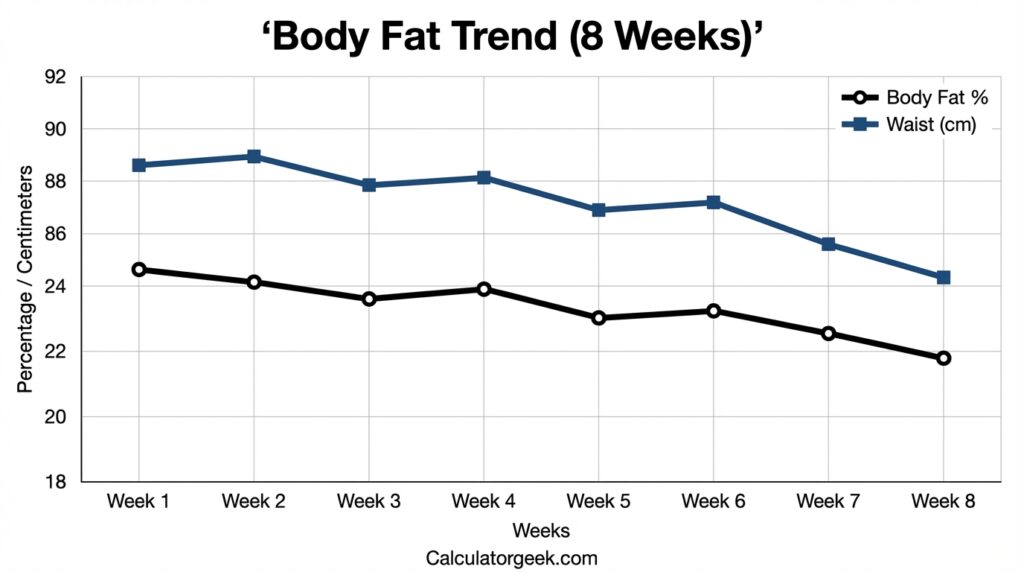
Alternative Methods of Measuring Body Fat
If you need something beyond a body fat calculator, the best alternative is the one you can access and repeat under similar conditions. Each method trades off convenience, cost, and sensitivity to day-to-day variables like hydration. [2][3][4]
1) Skinfold calipers (field method)
Skinfolds estimate body fat by measuring subcutaneous fat at specific sites, then applying a formula.
Best for: consistent tracking with a trained measurer
Watch-outs: site placement and tester skill matter; measurement error can rise when technique varies. [4]
Practical tip: if you use calipers, keep the same person, the same caliper, and the same sites every time.
2) BIA smart scales (bioelectrical impedance)
BIA estimates body composition from how your body resists a small electrical signal.
Best for: easy home tracking if you standardize conditions
Watch-outs: hydration and recent intake can shift readings; studies show measurable changes in BIA outputs with acute water intake and varying conditions. [5][6]
Practical tip: weigh at the same time (morning), similar hydration, and avoid measuring right after hard training.
3) DXA/DEXA (scan-based)
DXA is commonly used for bone density, and whole-body DXA can also estimate body composition (fat mass and lean mass distribution). [3]
Best for: an occasional baseline snapshot (e.g., 1–2 times/year)
Watch-outs: not needed for most day-to-day decisions; still not “perfect truth” for every individual. [3]
4) Hydrostatic weighing and air-displacement (lab methods)
These estimate body composition based on body density (underwater weighing) or air displacement.
Best for: controlled settings and periodic assessments
Watch-outs: access and convenience for regular tracking are limited.
5) BMI-based estimates (quick proxy)
BMI is a weight-for-height screening tool and does not directly measure body fat. It can misclassify muscular or lean individuals, which is why BMI-based body fat estimates are usually considered rough. [2]
Best for: a fallback when you only know height and weight
Watch-outs: don’t treat it like a precise body fat measurement.
Decision Framework: Choose the Right Method for You
The right choice is the method you can repeat consistently with the least friction, because consistency is what makes a body fat calculator (or any body fat method) decision-useful over time. For most people, that means tape-based measurements first, then optional cross-checks.
Step 1: Pick your primary method (your “default”)
Use this quick selector:
- If you want simple + repeatable: choose Tape/Circumference (Navy-style) as your default.
- If you have calipers and know technique: choose Skinfolds (same measurer each time).
- If you want daily convenience: choose BIA scale, but standardize conditions.
- If you want a periodic benchmark: use DEXA/DXA occasionally and trend with tape or BIA in between.
Step 2: Match method to your goal (if/then guide)
Step 3: Set “rules” that make your data reliable
- One primary method for at least 8 weeks
- One measurement day each week (same routine)
- One benchmark (optional) every 6–12 months, if you want a reality check
- No cross-method comparisons (don’t compare Navy% to BIA% like it’s the same scale)
Step 4: Use a clean adjustment rule (so you don’t overreact)
Only adjust your plan when:
- Your 4-week trend is flat and at least one supporting signal (waist or performance) agrees.
If the 4-week trend is unclear, your best “upgrade” is usually better measurement technique, not a new method.
Limitations, Disclaimer, and Ad & Content Safety Note
A body fat calculator provides an estimate based on generalized formulas and measurement assumptions. Your true body composition can differ due to hydration status, fat distribution, age, training background, and measurement technique.
Limitations to keep in mind
- Results are most reliable for trend tracking, not single-day precision.
- Different methods (Navy vs ADA vs BMI) can produce different values from the same person.
- At extremes of leanness or higher body fat, formula-based estimates may be less reliable.
Disclaimer (required)
“Tools information on Calculatorgeek is provided for general guidance and educational purposes only.”
Ad & Content Safety Note
This article is informational and avoids medical or financial guarantees.
Individual results vary, and no single calculator can diagnose health conditions.
If you have medical concerns, consider discussing body composition goals with a qualified clinician.
Author
Emma Clarke, MPH
Role: Editor
Bio: Emma is a public health writer and editor focused on practical health tools, measurement literacy, and evidence-based habit tracking. She specializes in helping readers understand what common calculators can (and can’t) estimate, and how to use results safely and consistently.
Reviewer
Daniel Reyes, RD, CSSD
Role: Clinical Reviewer
Bio: Daniel is a registered dietitian and sports dietetics specialist who reviews consumer health content for accuracy, clarity, and safety. His work emphasizes realistic goal-setting, sustainable nutrition habits, and avoiding over-interpretation of single metrics.
FAQs
1) How accurate is a body fat calculator?
A body fat calculator is usually accurate enough for trend tracking when you measure the same way each time, but single readings can vary by a few percentage points depending on method and technique. [1][2][3]
2) Which body fat calculator method should I choose: U.S. Navy, ADA, or BMI?
Use U.S. Navy if you can measure neck/waist (and hips for women) carefully, because circumference methods often track changes well with consistent technique. Use ADA for a quick estimate when you prefer fewer measurements. Use BMI-based only as a rough fallback when tape inputs aren’t available. [1][2]
3) Is it normal for my body fat percentage to change week to week?
Yes. Small weekly changes can come from water shifts, meal timing, posture, tape placement, or tape tension, not real fat gain or loss. Look at the 4–8 week direction using the same method. [2][3]
4) What’s the best time of day to use the body fat calculator?
Morning (after the bathroom, before food) is usually the most consistent time, because it reduces changes from meals, hydration, and daily activity. Consistency matters more than the exact hour. [2]
5) Why does my body fat calculator result look “too high” or “too low”?
Common reasons include measuring the waist at different landmarks, switching methods, unit mix-ups, or edge cases like unusual fat distribution or very muscular neck/traps. Re-check technique first before changing tools. [1][2]
6) Can I reduce body fat without losing muscle?
Often, yes—by keeping the calorie deficit modest, prioritizing protein, and doing resistance training consistently. Track progress using your body fat calculator trend plus waist and strength signals, not one metric alone. [2][3]
REFERENCES (authoritative, 2–4 max)
- American Council on Exercise (ACE) — Body Fat Percentage Categories (Men/Women)
Source used for the standard category ranges (essential fat, athletes, fitness, average, obese). - Centers for Disease Control and Prevention (CDC) — BMI: About & FAQs
Source used for the definition/limitations of BMI (not a direct measure of body fat; cannot distinguish fat vs lean mass). - National Library of Medicine (NLM/PMC) — Body Composition by DXA (2017 review)
Source used for DXA strengths/limitations and the reality that agreement and bias can vary by method/assumptions.