
Height Calculator
Height Calculator
Instant prediction (Mid-Parental) + Height converter.
People used this calculator
Your current platform: —
Global counter (server-side).
Height Calculator: Convert, Compare & Predict Height
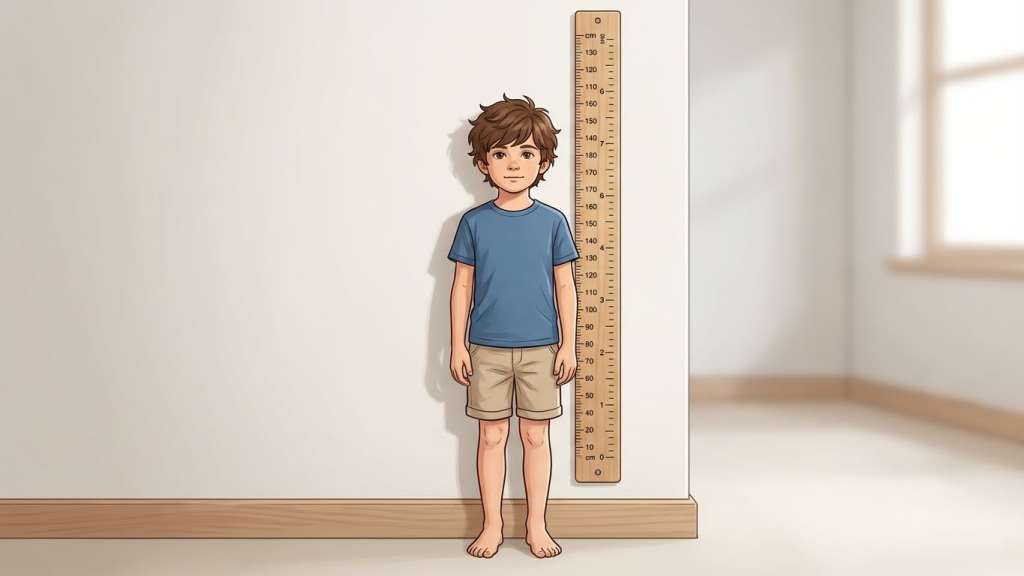
A height calculator helps you do three things people actually care about: convert height units, compare height with typical age-based growth patterns, and estimate future height using common prediction methods. So whether you’re filling out a school form, checking a sports profile, tracking growth at home, or simply curious, this page gives you quick results with context that makes sense.
To keep things practical, CalculatorGeek’s height tool should be built like a mini “height hub”:
Understand what affects height—genetics, sleep, nutrition, and growth timing
Convert feet/inches to centimeters (and back) in seconds
Compare results with growth charts (median vs mean trends)
Predict a child’s possible adult height using parent-based estimates
Related tools:
“Try the Height Calculator”
Convert Height Between Feet, Inches, and Centimeters
Most people use a height calculator because different systems are used in different places—medical forms, school records, sports profiles, or international documents. A reliable tool should let users enter height naturally and get an exact result without rounding errors.
A well-built converter should:
- Accept feet and inches together (not just decimal feet)
- Convert instantly to centimeters
- Display results clearly and consistently
Conversion standards used:
- 1 inch = 2.54 centimeters
- 1 foot = 12 inches = 30.48 centimeters
These values are internationally standardized and ensure consistent results across devices and platforms.
“Convert height from feet and inches to centimeters instantly.”
Common Height Conversions (Quick Reference)
| Height | Centimeters |
|---|---|
| 5’0” | 152.4 cm |
| 5’4” | 162.6 cm |
| 5’8” | 172.7 cm |
| 6’0” | 182.9 cm |
This table helps users confirm their results at a glance and improves snippet eligibility in search results.
How to Measure Height Correctly at Home
Even the most accurate calculator can’t help if the measurement itself is off. Small mistakes—shoes, posture, uneven floors—can easily change the result by a centimeter or more.
Correct height measurement checklist:
- Measure barefoot on a hard, flat surface
- Stand straight with heels close to the wall
- Keep eyes looking forward (chin level)
- Use a flat object (book or ruler) at a right angle on the head
- Measure from the floor to the mark
- Repeat once and use the average
Tip: Height can vary slightly during the day. Measuring at the same time (often morning) improves consistency.
“You can also check your BMI calculator using your height and weight.”
Height and Genetics—Why Family Traits Matter Most
When people talk about height, they usually say “It’s genetic,” and they’re mostly right—but it’s helpful to know what that actually means. Genetics doesn’t decide one exact final number the way a recipe decides a cake. It works more like a range—a realistic “zone” your body is likely to land in, assuming normal health and supportive habits.
Why height runs in families
Height is influenced by many genes, not one. That’s why:
- Two tall parents can have an average-height child
- Two average-height parents can have a tall child
- Siblings can end up noticeably different
Your child inherits a mix of traits from both sides of the family tree, not just parents. Grandparents, aunts, uncles—those patterns sometimes show up in surprising ways.
Why calculators use parent height
This is exactly why parent-based tools tend to be more useful than “age-only” guesses. When a calculator asks for both parents’ heights, it’s trying to approximate the genetic zone. That’s the foundation behind a height calculator by parents approach—simple, logical, and usually more grounded than tools that ignore family data.
Genetics still isn’t the whole story
Even with strong genetics, a few things can shift how growth plays out:
- Puberty timing (early vs late bloomers)
- Long-term nutrition consistency
- Sleep patterns over years
- Health factors that affect hormones or absorption
This is why the best height tools don’t just show a number—they also show charts and ranges and explain what can influence the result.
A realistic way to think about it
If genetics is the “blueprint,” then childhood conditions are the “construction crew.” Most kids with supportive sleep, diet, and general health end up somewhere near the family height range. The calculator helps users understand that range—without overpromising.
“How Tall Will I Be?” Estimating a Child’s Adult Height
One of the most common questions parents and teenagers ask is simple but emotionally loaded: “How tall will I be?” A height calculator can’t give a guaranteed final number, but it can provide a realistic estimate range based on known patterns of human growth.
What height prediction really means
Height prediction is not fortune-telling. It’s a data-informed estimate that combines:
- Current age and height
- Sex-based growth patterns
- Family height information
- Population growth references
The result is best understood as a probable range, not a promise. Two children with the same inputs can still end up different heights due to differences in growth timing, especially during puberty.
Why estimates change as children grow
Predictions become more stable as a child gets older, but they can still shift. Common reasons include:
- Early or late puberty: Late bloomers may appear shorter for years, then catch up quickly.
- Growth spurts: These often happen in bursts, not steadily.
- Measurement updates: Small changes in measurement accuracy can affect estimates.
- Lifestyle factors: Long-term nutrition and sleep patterns matter more than short-term changes.
This is why a good calculator encourages users to recheck periodically rather than relying on a single result forever.
How to interpret your result responsibly
When the calculator shows an estimated adult height:
- Focus on the range, not the midpoint alone.
- Compare results with growth charts, not classmates.
- Look at trends over time, not one measurement.
If a child’s estimated range suddenly drops or growth appears to slow compared with earlier patterns, that’s a signal to seek professional advice—not to panic, but to get clarity.
The Khamis–Roche Child Height Predictor
The Khamis–Roche child height predictor is one of the most commonly referenced non-clinical methods for estimating a child’s adult height. It’s popular because it uses information families usually already know and doesn’t require medical imaging or lab tests.
What the Khamis–Roche method uses
This approach combines:
- The child’s current age
- The child’s current height
- The child’s current weight
- The heights of both parents
By blending these inputs with long-term population growth data, the method estimates a likely adult height range rather than a single fixed number.
Why this method is widely used
Parents and educators often prefer this approach because:
- It’s non-invasive (no X-rays or scans)
- It works well for school-age children
- It provides a range, which better reflects real growth patterns
- It’s easy to update as the child grows
This makes it a practical option for everyday guidance rather than clinical diagnosis.
How accurate is it in real life?
Like all prediction tools, the Khamis–Roche method has limits. It tends to perform best when:
- Measurements are taken accurately
- The child follows a typical growth pattern
- There are no underlying medical conditions affecting growth
Estimates can still change, especially around puberty, when growth timing varies widely between individuals.
How to interpret Khamis–Roche results
When using this predictor:
- Treat the midpoint as a reference, not a target
- Pay attention to the upper and lower bounds
- Recheck periodically as new measurements become available
If the predicted range shifts significantly over time, it’s a sign to look at the broader growth pattern rather than focusing on one number.
Mid-Parental Height Calculator and Formula (Parent-Based Estimate)
If you’ve ever heard someone say, “Just average the parents’ heights,” they’re referring to the idea behind the mid-parental height method. It’s one of the most common ways to estimate a child’s adult height because it’s simple, quick, and based on the biggest driver of height: genetics.
This approach is especially useful when parents want a starting point—a rough genetic “zone”—before looking at charts, growth trends, or more detailed methods.
What the mid-parental method is (in plain terms)
The method uses:
- Mother’s height
- Father’s height
- A small adjustment based on sex-specific growth patterns
It doesn’t try to predict exactly when growth spurts will happen. Instead, it gives a reasonable expectation range based on family height.
The mid-parental height formula
To keep this AdSense-safe and user-friendly, present this as an “education box” with a short disclaimer.
For boys:
- (Father’s height + Mother’s height + 13 cm) ÷ 2
For girls:
- (Father’s height + Mother’s height − 13 cm) ÷ 2
This aligns with the classic parent-based estimation logic and is commonly used as a baseline reference in growth discussions.
How to use it without overthinking
The best way to position this method on CalculatorGeek is as:
- A baseline estimate, not a final verdict
- Something users should pair with growth charts and trend tracking
- A tool to reduce anxiety, not increase it
You can add a short note like:
“Many children fall within a few inches (or several cm) of this estimate, but timing of puberty and environment can shift outcomes.”
Where this method can be less reliable
The mid-parental estimate can be less stable when:
- Puberty timing is significantly early or late
- Measurements are inconsistent (shoes, posture, rounding)
- Growth patterns change noticeably over time
This is why CalculatorGeek should show results as:
- Estimated adult height
- A reasonable range (example: ± 5–8 cm)
- A short explanation of what can influence the outcome
Bone Age and Skeletal Maturity—A More Advanced Height Prediction
When parents want a more detailed answer than “genetics + charts,” they often come across the term bone age. Bone age is a way of estimating skeletal maturity—in other words, how developed a child’s bones are compared to what’s typical for their chronological age. This matters because bones grow from growth plates, and growth plates gradually close as skeletal maturity increases.
A key point for CalculatorGeek to communicate clearly: bone age is not something a website calculator can determine. It’s assessed by clinicians using imaging and professional interpretation. Still, understanding the concept helps users interpret prediction results more realistically—especially when a child is an early or late grower.
What bone age means (simple explanation)
- Chronological age = age on the calendar
- Bone age = how mature the skeleton appears for that age
Sometimes a child’s bone age is:
- Advanced (skeletal maturity looks older than the child’s age)
- Delayed (skeletal maturity looks younger than the child’s age)
This can help explain common real-world scenarios. For example, a child who’s shorter than peers might still have plenty of growth potential if skeletal maturity is delayed—while another child who had an early growth spurt may have less remaining growth even if they look tall now.
How bone age relates to height prediction
Bone maturity provides insight into how much growth may be left, not just what the “genetic estimate” might be. That’s why bone age is sometimes used in clinical growth evaluations.
In content terms, this section supports your prediction modules by explaining:
- Why two kids with similar parent heights can grow differently
- Why puberty timing shifts predictions
- Why chart interpretation should consider growth timing, not just current height
Where to mention it (without giving medical advice)
On the CalculatorGeek page, position bone age like this:
- “Some advanced medical evaluations use skeletal maturity (bone age) to better understand remaining growth potential.”
- “This tool does not calculate bone age and cannot replace professional assessment.”
That wording builds trust while keeping the page safe for AdSense and compliant with health-content expectations.
When it’s smart to seek professional guidance
Keep this calm and responsible—no fear language. Mention that professional evaluation may be useful if:
- Growth slows noticeably over time
- A child drops across growth percentiles
- Puberty timing seems unusually early or late
- There are persistent concerns about growth patterns
This is also an appropriate place to briefly mention that clinicians may evaluate hormone-related issues such as growth hormone deficiency as part of a broader assessment (no diagnosis claims; no treatment talk).
“Learn more”
MedlinePlus (general health info) or
Growth Charts—How to Read the Attached Charts the Right Way
Why growth charts matter more than a single number
A height prediction is helpful, but charts answer the deeper question:
“Is this height typical for this age?”
That’s why a chart section is a ranking advantage. Competitors often show formulas and outputs, but many don’t help users interpret what “normal variation” looks like over time. Your charts do—and that improves user satisfaction, time-on-page, and trust.
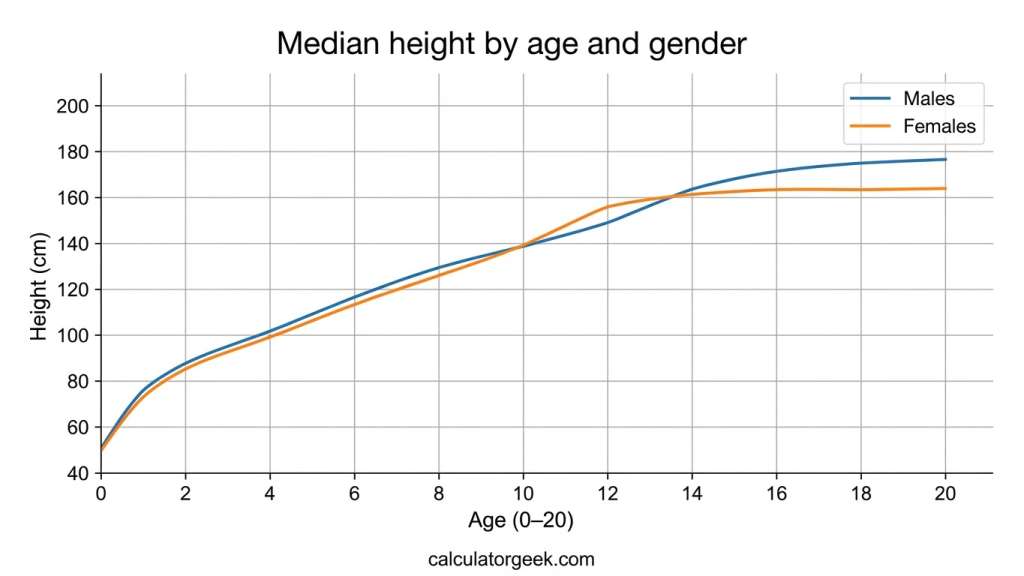
“Mean height by age and gender chart (US average)”
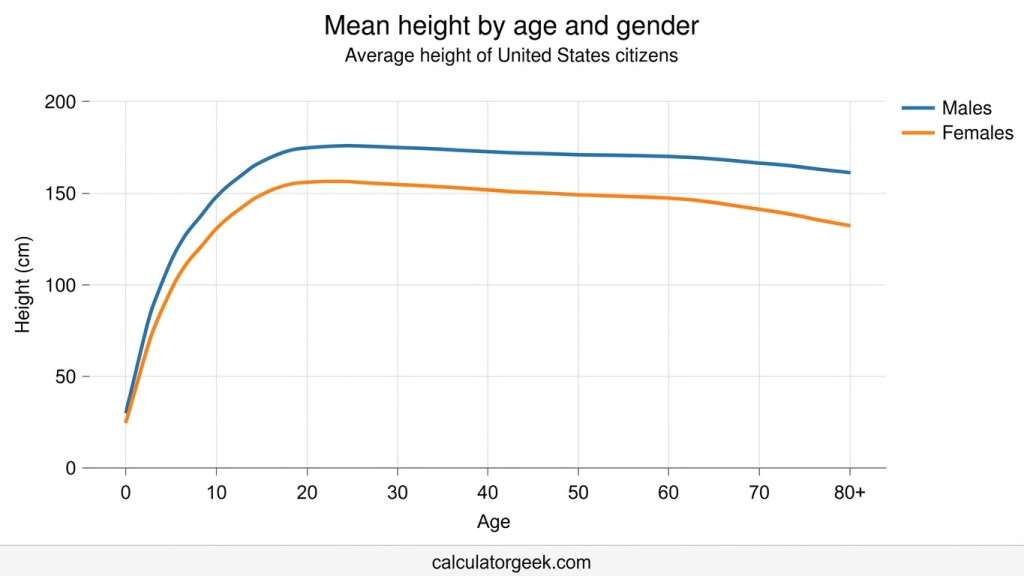
Median vs Mean (the key difference in your charts)
Your visuals show both median and mean height trends by age and gender:
- Median height = the middle value (50th percentile idea). Half the population is taller, half is shorter.
- This is often the best “typical” reference because it’s less influenced by extremes.
- Mean height = the mathematical average.
- Useful for broad comparison, especially across adult age groups where averages may drift slightly.
📌 Microcopy to place under Chart #1 (2 lines max):
“Median shows the midpoint height for each age. It’s a strong ‘typical’ benchmark.”
📌 Microcopy to place under Chart #2 (2 lines max):
“Mean shows the average height. Small shifts in older age groups can reflect posture and spinal compression.”
How to read the chart like a normal person (not a statistician)
Here’s a simple way users can interpret the lines:
- Look at age on the bottom axis and follow upward to the line for male/female.
- Find the height value on the side axis where it meets the line.
- Compare trend, not just today’s point.
- One measurement is a snapshot
- A pattern over time is a story
That “trend over time” idea is important because it prevents unnecessary worry. Two kids can be healthy at very different heights—what matters is whether growth stays generally consistent.
What users usually notice in these charts
Most users will immediately see these real-life patterns:
- Early childhood: faster growth early, then steadier growth.
- Puberty window: the line climbs more quickly during the growth spurt years.
- Late teens: the lines flatten as growth slows.
- Adults: curves stabilize, and later age groups may show small declines.
This is exactly why charts pair so well with prediction tools: they help explain why a child may be “behind” peers one year and “caught up” later.
“Growth charts are reference tools, not diagnoses. If a child’s growth pattern changes sharply over time—especially if they drop across multiple percentiles—professional guidance can help clarify what’s going on.“
“References”
CDC Growth Charts: https://www.cdc.gov/growthcharts/
WHO Child Growth Standards: https://www.who.int/tools/child-growth-standards
CDC Growth Charts: https://www.cdc.gov/growthcharts/
When Do Girls Typically Stop Growing?
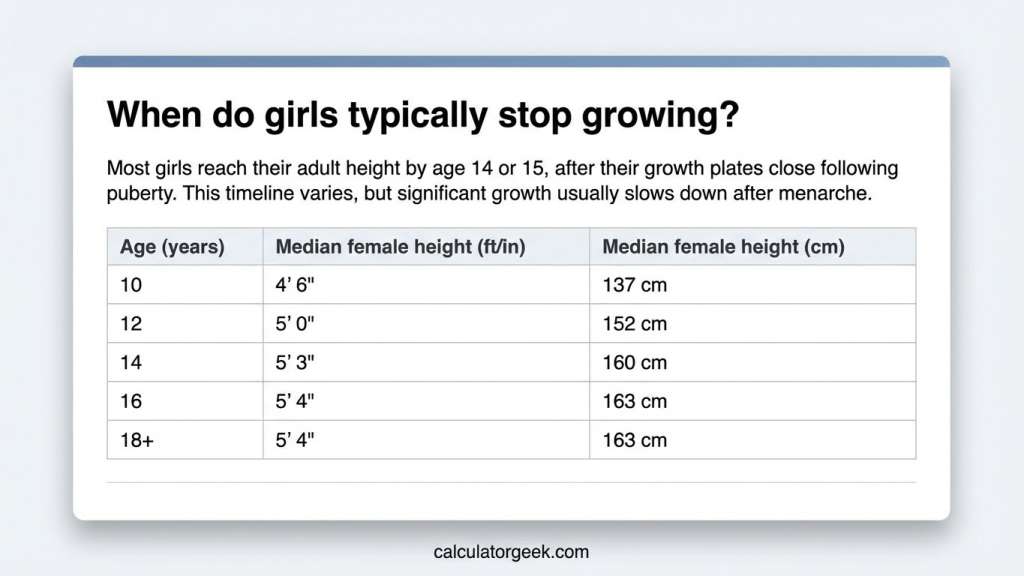
Many users land on a height page with a very specific question: when do girls stop growing? The honest answer is that there isn’t one universal age that applies to everyone—but there are clear patterns seen in growth charts. In general, growth tends to speed up earlier during adolescence for girls, then gradually slows as the body approaches full maturity. That’s why many girls reach their near-adult height earlier than boys.
This is where your attached table becomes especially useful. It gives visitors an easy way to compare age and typical height ranges without requiring them to interpret an entire chart. The key is to frame this data as context, not a “goal.” Height varies naturally from person to person, and being shorter or taller than an average doesn’t automatically mean anything is wrong.
How to use the table on your page (so it helps SEO and users)
Right under the table image, add a short “How to read this” block:
- The table shows typical height values by age, based on population references.
- It’s meant for quick comparison, not medical diagnosis.
- The most important signal is growth trend over time, not one measurement.
To meet user intent while keeping a responsible tone, include a brief mention of average female height as a benchmark—not a standard. Then immediately clarify that averages vary by country and dataset, which keeps the content accurate and trustworthy.
What parents should watch instead of obsessing over the exact number
If you want this section to feel genuinely helpful (and not like recycled content), keep it practical:
- Consistent growth over time is usually reassuring.
- A one-time “short” measurement often comes down to technique or timing.
- Growth can happen in spurts—quiet months followed by sudden change.
If a child’s height trend drops sharply across percentiles or growth slows noticeably over time, that’s the moment when professional guidance can help clarify what’s happening—without panic or assumptions.
When Do Boys Typically Stop Growing?

A lot of people ask, when do boys stop growing? and the reason the answers online feel inconsistent is because growth timing can vary a lot—especially through adolescence. In general, boys tend to hit their major growth spurt later than girls and may continue growing a bit longer before the growth plates fully close. That’s why two boys the same age can look like they’re in totally different “growth phases,” even if both are developing normally.
Your attached table is ideal here because it turns a confusing question into something users can actually interpret. Instead of guessing, they can look at a typical height range by age and understand what’s common—without treating it as a pass/fail score. This is also a natural place to mention average male height once as a benchmark, with a quick note that averages differ by country and dataset.
How to interpret the boys’ growth table (so users don’t misread it)
Under the table image, add a short “How to read this table” block:
- Values reflect typical population references, not individual destiny.
- The table is most helpful when you compare several measurements over time.
- If someone is below the average, it may simply mean they’re a later grower.
This single explanation prevents misinterpretation and improves trust, which helps both SEO and user satisfaction.
What’s normal during the teen years
This is where your content can feel genuinely helpful rather than generic. Include these reality checks:
- Growth often happens in spurts, not steady weekly changes.
- Puberty timing affects whether a teen looks “early” or “late” compared to peers.
- A consistent growth trend is more meaningful than a single height check.
If a teen’s growth seems to slow dramatically, or if their growth pattern drops sharply across percentiles, that’s the appropriate moment to recommend professional guidance—calmly and responsibly.
How to Get Taller—What’s Realistic, What Helps, and What’s a Myth
Let’s talk about the question people hesitate to ask out loud but type into Google all the time: how to get taller? The answer depends on one thing—whether you’re still growing. If growth plates are still open (usually kids and teens), healthy habits can help you reach your natural height potential. If growth plates have closed (most adults), you generally can’t increase bone length naturally—but you can improve posture, measurement consistency, and the way you carry your height.
If you’re a teen or still growing
This isn’t about magic tricks—it’s about giving your body the best conditions to follow its growth plan.
What actually supports healthy growth:
- Consistent sleep: Deep sleep supports the body’s growth processes. Teens who chronically sleep too little may not support optimal growth patterns.
- Balanced nutrition: Long-term under-eating, poor protein intake, or low micronutrients can impact development. Focus on steady meals with protein, calcium-rich foods, fruits/veg, and hydration.
- Regular activity: Sports and movement don’t “stretch you taller,” but they strengthen bones, support posture, and keep the body functioning well.
- Healthy routines: Long-term stress and irregular schedules can affect appetite, recovery, and overall wellbeing—things that matter during growth years.
What to avoid (because it backfires):
- Extreme diets (especially in growth years)
- Overtraining without enough recovery
- “Supplements” marketed as height boosters (often expensive and unproven)
If you’re an adult
Here’s the honest truth: once growth plates close, you generally can’t increase bone length naturally. But adults often “gain height” on paper by improving posture and measurement habits—because slouching, tight hips, weak core muscles, and poor neck alignment can make your measured height smaller than it should be.
How adults can appear taller (and sometimes measure taller):
- Posture improvements: Standing tall with neutral spine alignment can change measured height slightly.
- Strength + mobility: Core strength, back strength, and hip mobility reduce the “collapsed” look.
- Daily habits: Sitting hunched over screens for years can compress posture patterns—fixing that can make a visible difference.
- Measure correctly: Same time of day, barefoot, same method—this reduces variation and confusion.
A practical mini-routine (simple and safe):
- Wall stands (back against wall, neutral head position)
- Gentle chest opening stretches
- Hip flexor mobility work
- Core stability exercises (like dead bug or plank variations)
This doesn’t create new bone length—but it helps you use the height you already have.
Common myths worth clearing up
To build trust (and reduce bounce), include a short myth-buster block:
- Myth: “Stretching makes adults permanently taller.”
Reality: Stretching can improve posture and reduce tightness, but it doesn’t lengthen bones permanently. - Myth: “A pill can add inches.”
Reality: Most “height supplements” are unverified marketing. Nutrients help if there’s a deficiency—but they don’t override genetics. - Myth: “Sports like basketball make you taller.”
Reality: Taller people may gravitate toward those sports; the sport itself doesn’t create height.
This kind of straight talk improves EEAT and reader trust.
FAQs
FAQ 1: How do I convert feet and inches to centimeters?
Enter your height in feet and inches (example: 5 ft 9 in). The calculator converts inches to centimeters using 2.54 cm per inch and adds the feet portion using 30.48 cm per foot. This avoids rounding mistakes and gives a clean result for forms and apps.
📌 Link placement (internal, one only in this answer):
Add a link to your Unit Converter (anchor: “unit converter”) if you have a general conversion tool.
FAQ 2: How accurate is a height prediction calculator for kids?
It’s an estimate range, not a guarantee. Parent-based prediction methods can be useful for general guidance, but results may shift because of puberty timing, growth spurts, measurement updates, and overall health. The most reliable way to use it is to track growth over time and compare trends using charts, not just one result.
FAQ 3: Why does my height change between morning and night?
Many people measure slightly taller in the morning and slightly shorter at night. That’s because the spine compresses naturally throughout the day while standing and moving. Measuring at the same time of day helps keep results consistent.
FAQ 4: What does “median height” mean on a growth chart?
Median height is the middle value in a population for that age group. If a child is at the median, about half of children are taller and half are shorter. It’s a useful “typical” reference and often more stable than averages when interpreting charts.
FAQ 5: When should parents be concerned about a child’s growth?
A single short measurement usually isn’t enough to worry about. What matters is the trend over time. If growth slows noticeably, or a child drops across percentiles consistently, it’s a good idea to speak with a qualified healthcare professional for guidance.
FAQ 6: Can adults get taller naturally?
Adults typically can’t increase bone length after growth plates close. However, posture improvements, strength and mobility work, and consistent measurement technique can help you stand taller and reduce day-to-day measurement variation.
External references:
CDC Growth Charts (Height-for-age references): https://www.cdc.gov/growthcharts/
WHO Child Growth Standards: https://www.who.int/tools/child-growth-standards
MedlinePlus (General health information): https://medlineplus.gov/
