

Cubic Yard Calculator
Estimate volume and cost for multiple shapes. Results update automatically as you type.
People used this calculator
Your current platform: —
Global counter (server-side).
Cubic Yard Calculator: Convert Measurements Into Cubic Yards
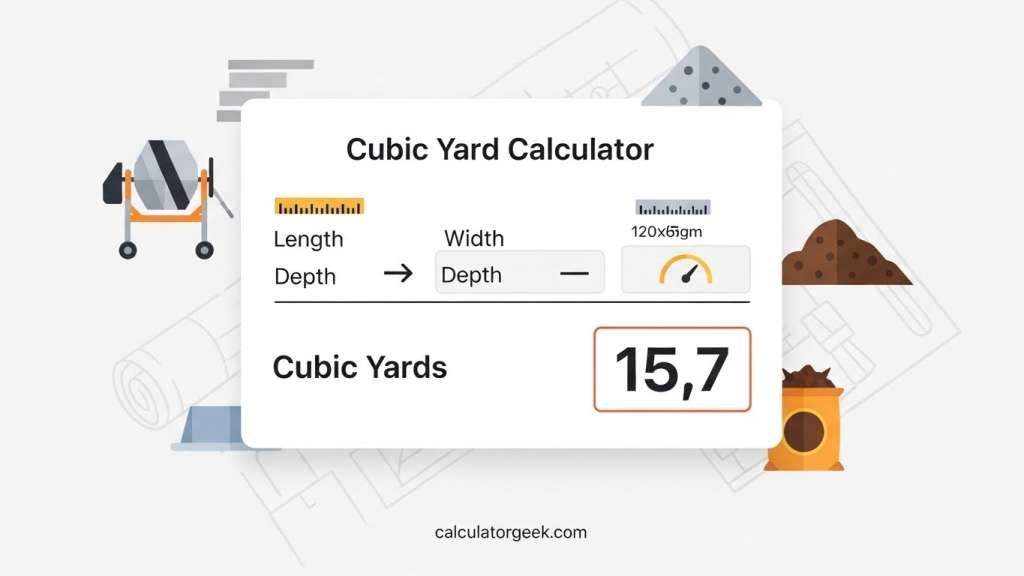
A cubic yard calculator converts your measurements into cubic yards, helping you estimate how much concrete, gravel, soil, dirt, rock, or mulch to order for a project.
What This Tool Calculates
This tool is designed for calculator + informational intent: get the yardage number you need, plus the guidance that helps you order confidently.
Use it for:
- Concrete (pads, slabs, footings) Cubic Yard Ccalculator keywords
- Gravel / rock (paths, driveways, base layers) Cubic Yard Ccalculator keywords
- Dirt / soil (grading, raised beds, backfill) Cubic Yard Ccalculator keywords
- Mulch (beds, tree rings, playground areas) Cubic Yard Ccalculator keywords
- Shapes beyond rectangles such as cylinders for post holes or triangles for tapered fills Cubic Yard Ccalculator keywords Cubic Yard Ccalculator keywords
What Is a Cubic Yard?
A cubic yard is a unit of volume equal to a cube measuring 1 yard × 1 yard × 1 yard. Since 1 yard = 3 feet, that means:
- 1 cubic yard = 27 cubic feet Cubic Yard Ccalculator keywords
That’s why many people calculate volume in feet first, then convert to yards for ordering.
How the Calculator Works
At a high level, the calculator:
- Calculates volume based on your chosen shape (rectangle, circle, etc.).
- Converts measurements into a consistent base unit (commonly cubic feet).
- Converts the result into cubic yards for purchasing.
- Supports real-world ordering with coverage tables, bag equivalents, and overage guidance.
How to Use a Cubic Yard Calculator
- Choose the shape that matches your space
- Rectangle (slabs, beds)
- Circle (tree rings)
- Cylinder (post holes)
- Triangle/Trapezoid (ramps, tapered areas)
- Measure and enter dimensions
- Measure length/width at widest points
- For depth, take multiple readings if the ground varies and use an average
- Check the result
- Use the coverage and overage sections below to confirm your order quantity.
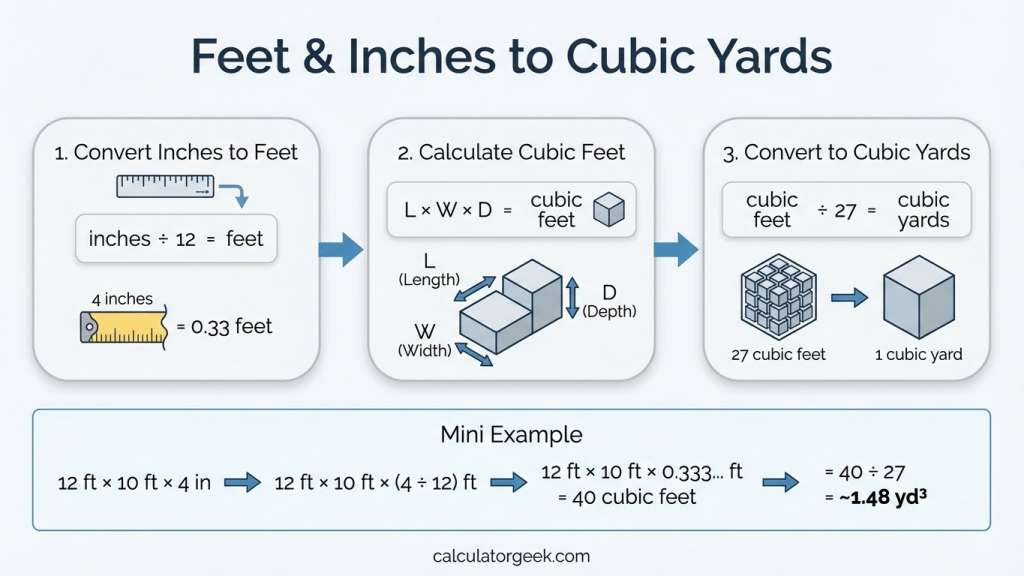
How to Calculate Cubic Yards Using Feet and Inches
This is the most common scenario: your tape measure gives feet/inches, but you need cubic yards.
Step 1: Convert inches to feet (only where needed)
Use: feet = inches ÷ 12
Examples:
- 4 inches = 0.333 ft
- 6 inches = 0.5 ft
- 12 inches = 1 ft
Step 2: Calculate cubic feet
For a rectangle: cubic feet = length(ft) × width(ft) × depth(ft)
Step 3: Convert cubic feet to cubic yards
Use: cubic yards = cubic feet ÷ 27 Cubic Yard Ccalculator keywords
Quick Example (slab)
A slab is 12 ft × 10 ft × 4 in:
- Convert depth: 4 in ÷ 12 = 0.333 ft
- Cubic feet: 12 × 10 × 0.333 ≈ 39.96 ft³
- Cubic yards: 39.96 ÷ 27 ≈ 1.48 yd³
Tip: For ordering, many people round up slightly and add a small overage (see the overage table later).
Cubic Yard Material Coverage Guide
Coverage Per 1 Cubic Yard by Depth
| Depth (in) | Coverage (sq ft) |
|---|---|
| 1 | 324 |
| 2 | 162 |
| 3 | 108 |
| 4 | 81 |
| 6 | 54 |
| 12 | 27 |
Formula: coverage (sq ft) = 324 ÷ depth (inches)
Square Feet to Cubic Yards by Depth
Cubic Yards Needed at Popular Depths
| Area (sq ft) | 2″ | 3″ | 4″ |
|---|---|---|---|
| 100 | 0.62 | 0.93 | 1.23 |
| 200 | 1.23 | 1.85 | 2.47 |
| 300 | 1.85 | 2.78 | 3.70 |
| 500 | 3.09 | 4.63 | 6.17 |
| 1000 | 6.17 | 9.26 | 12.35 |
Formula: yd³ = (sq ft × inches) ÷ 324
Related Calculators: Square Footage Calculator
Bags Per Cubic Yard
How Many Bags Equal One Cubic Yard
| Bag Size (cu ft) | Bags per yd³ |
|---|---|
| 0.5 | 54 |
| 0.75 | 36 |
| 1.0 | 27 |
| 1.5 | 18 |
| 2.0 | 13.5 |
| 3.0 | 9 |
Formula: Bags per yd³ = 27 ÷ bag size (ft³)
Recommended Depths by Use
| Use Case | Depth (in) | Notes |
|---|---|---|
| Garden beds | 2–3 | Keep mulch off stems |
| Tree rings | 2–3 | Leave a mulch-free donut around trunk |
| Paths (mulch) | 3–4 | Use edging to hold in place |
| Playground mulch | 8–12 | Follow safety guidelines |
| Gravel paths | 3–4 | Compact in lifts |
| Gravel base under pavers | 4–6 | Depends on soil and load |
| Lawn topdressing (soil) | 0.25–0.5 | Thin layers help avoid smothering |
Recommended Waste and Overage
| Project Type | Suggested Extra (%) | Why |
|---|---|---|
| Decorative mulch | 5–10 | Edges and settling |
| Gravel paths | 10–15 | Compaction and rake loss |
| Stone base under pavers | 10–15 | Compaction in lifts |
| Topsoil grading | 5–10 | Contouring and low spots |
| Concrete | 5 | Spillage, edge forms |
| Playground mulch | 10–20 | Kick-out and level changes |
Related Calculators: Asphalt Calculator
Cubic Yards Formulas by Shape
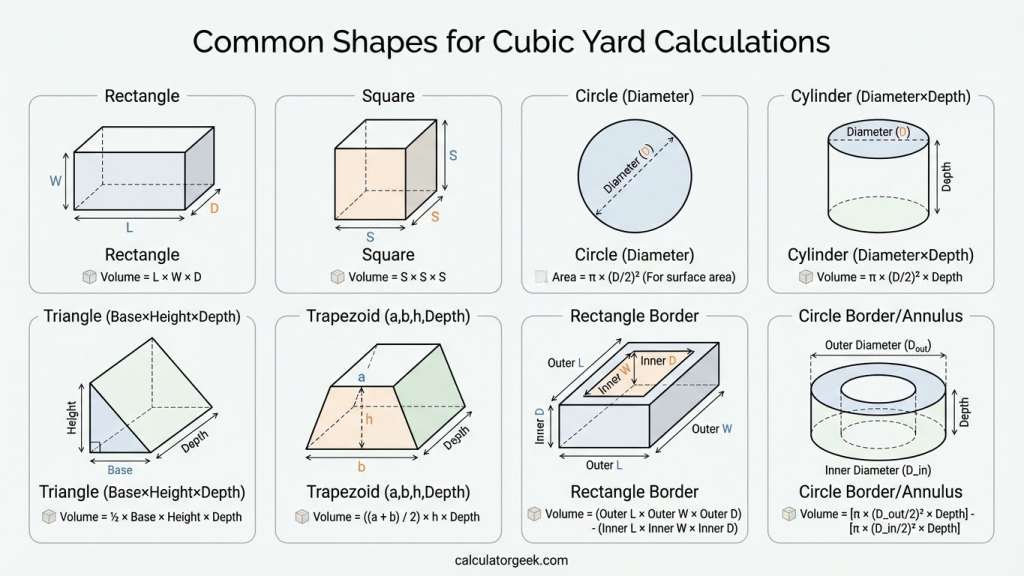
Square
- Area (ft²) = Side × Side
- Volume (ft³) = Depth × Area
- Volume (yd³) = Volume (ft³) ÷ 27
Rectangle
- Area (ft²) = Length × Width
- Volume (ft³) = Depth × Area
- Volume (yd³) = Volume (ft³) ÷ 27
Rectangle Border
- Inner Area (ft²) = Length × Width
- Total Area (ft²) = [Length + (2 × Border Width)] × [Width + (2 × Border Width)]
- Border Area (ft²) = Total Area − Inner Area
- Volume (yd³) = (Depth × Border Area) ÷ 27
Circle
- Area (ft²) = π × (Diameter ÷ 2)²
- Volume (yd³) = (Depth × Area) ÷ 27
- Use π ≈ 3.14.
Circle Border (Annulus)
- Outer Diameter = Inner Diameter + (2 × Border Width)
- Area (ft²) = π × (Outer Diameter ÷ 2)² − π × (Inner Diameter ÷ 2)²
- Volume (yd³) = (Depth × Area) ÷ 27
Triangle
- Area (ft²) = 1/2 × Base × Height
- Volume (yd³) = (Depth × Area) ÷ 27
Trapezoid
- Area (ft²) = ((a + b) ÷ 2) × h
- Volume (yd³) = (Depth × Area) ÷ 27
Conversions and Quick Yardage Questions
How much is a cubic yard?
A cubic yard equals 27 cubic feet—a 3D volume often used for bulk ordering.
How do I convert cubic feet to cubic yards?
cubic yards = cubic feet ÷ 27 Cubic Yard Ccalculator keywords
How do I convert cubic inches to cubic yards?
A safe approach is:
- Convert inches-based dimensions to feet first (divide each inch measurement by 12), then calculate volume, then divide by 27 for cubic yards.
How to estimate volume from square feet to cubic yards?
Use depth + area:
- yd³ = (sq ft × inches) ÷ 324
Contextual external link: NIST Weights and Measures
https://www.nist.gov/pml/weights-and-measures
Common Mistakes and Fixes
- Mixing inches with feet (convert depth first)
- Using area without depth
- Ignoring compaction/settling
- Measuring uneven depth once instead of averaging
- Ordering exact yardage with no buffer
Why real-world yardage can differ
Even with accurate measurements, material moisture, compaction, delivery method, and base preparation can affect final volume. This is why professionals often round up slightly instead of ordering exact yardage.
Limitations and Disclaimer
Results are estimates based on your inputs. Real material needs vary due to surface irregularities, compaction, moisture, and supplier delivery rules. For structural work (especially concrete and load-bearing bases), follow local requirements and professional guidance.
FAQs
How to calculate cubic yard?
Measure the space, calculate volume for the shape, then convert to cubic yards (most calculators do this instantly).
Is a cubic yard 3 ft by 3 ft?
Yes—3 ft × 3 ft × 3 ft equals 1 cubic yard (27 cubic feet).
How much will 1 cubic yard cover?
At 4 inches deep, about 81 sq ft; at 6 inches deep, about 54 sq ft (approximate).
How do I convert cubic feet to cubic yards?
Divide cubic feet by 27.
How do I estimate cubic yards from square feet?
Use depth. Shortcut: yd³ = (sq ft × inches) ÷ 324.
Can this be used for soil, gravel, rock, dirt, and mulch?
Yes—volume math is the same; just consider compaction/settling with the overage table.
References:
https://www.nist.gov/pml/weights-and-measures
https://en.wikipedia.org/wiki/Cubic_yard
EEAT & Trust Notes (CalculatorGeek)
How CalculatorGeek Ensures Accuracy
CalculatorGeek tools are built with a user-first accuracy approach. Every calculator is:
- Based on standard measurement principles commonly used in construction and engineering
- Reviewed for unit consistency (feet, inches, cubic feet, cubic yards)
- Designed to reflect real-world usage, including compaction, waste, and ordering practices
- Updated when industry conventions or best-practice guidance changes
Our goal is not just to produce numbers, but to help users make confident, informed decisions when planning projects.
Expert Review & Content Oversight
All construction-related calculators and guides on CalculatorGeek are reviewed or supervised by subject-matter experts with professional engineering backgrounds.
This ensures calculations align with practical field knowledge, not just textbook formulas.
Important Accuracy Note
Results from this Cubic Yard Calculator are estimates intended for planning and comparison purposes. Actual material requirements may vary due to:
- Surface irregularities and grading conditions
- Compaction and settling (especially for gravel, soil, and base layers)
- Moisture content and delivery method
- Local construction practices and supplier rounding rules
For structural or load-bearing projects, always verify final quantities with a qualified professional or supplier.
Author & Expert Reviewer Bio
About the Author
Zulfiqar Ali, PhD (Civil Engineering)
Civil Engineer | Construction & Materials Specialist
Zulfiqar Ali is a Civil Engineer with a PhD in Civil Engineering, specializing in construction materials, volume estimation, and infrastructure planning. He has extensive experience in:
- Concrete and aggregate volume estimation
- Construction measurement standards
- Site planning and material optimization
- Academic research in civil engineering practices
His expertise helps ensure that CalculatorGeek’s construction calculators reflect real-world engineering logic, practical safety margins, and industry-accepted methods.
Editorial Standards at CalculatorGeek
CalculatorGeek follows a structured editorial process:
- ✅ Calculators are reviewed for mathematical correctness
- ✅ Explanations are written for clarity, not assumptions
- ✅ Content avoids unsupported claims or misleading simplifications
- ✅ Tools are updated when errors or improvements are identified
This commitment helps maintain trust with users, search engines, and AI-powered discovery platforms.