Board Foot Calculator — Calculate Lumber Volume Fast
Board Foot Calculator
Enter the dimensions of your lumber to estimate total board feet and volume.
People used this calculator
Your current platform: —
This total is local for your browser and simulates a global counter for users (desktop and mobile) using this calculator on CalculatorGeek.com.
Board Foot Calculator (Board Feet, Tally & Pricing)
Use this Board Foot Calculator to calculate board feet, build a lumber tally, and estimate material cost accurately.
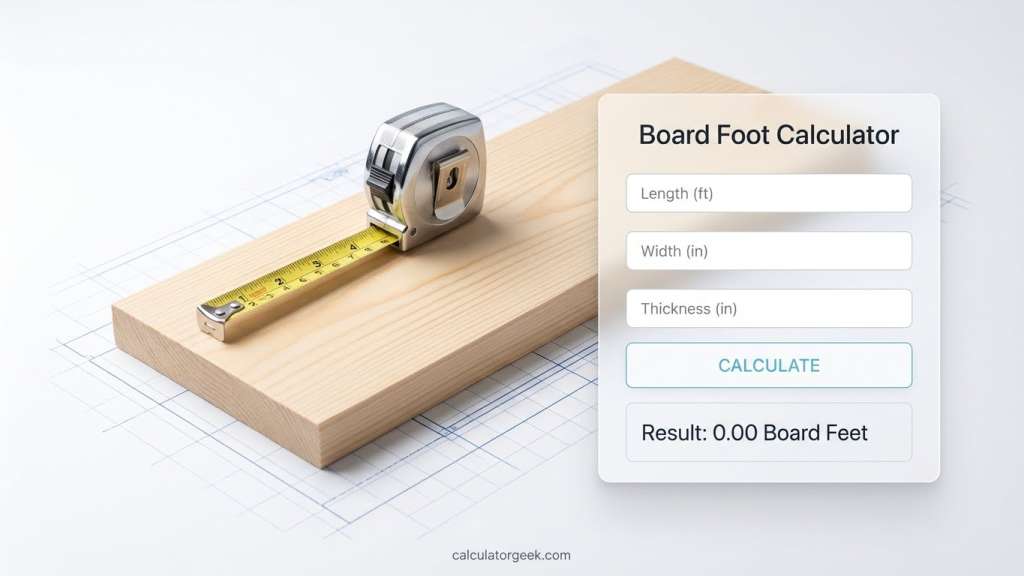
This Board Foot Calculator helps you measure lumber volume using thickness, width, and length, converting real board dimensions into accurate board feet. It equals a piece of wood that’s 12 inches × 12 inches × 1 inch. This Board Foot Calculator converts your board dimensions (thickness, width, and length) into board feet, totals multiple boards into a clean tally, and helps you estimate cost when you know the rate per board foot.
It’s designed for woodworkers, contractors, and DIY builders who want fast, dependable numbers for ordering, budgeting, and verifying a lumber purchase—without manual math or unit confusion.
The Board Foot Calculator is commonly used in woodworking and construction to standardize lumber volume, making it easier to compare boards, estimate material needs, and control project costs. This Board Foot Calculator eliminates manual calculations and unit confusion.
What This Tool Calculates
This Board Foot Calculator is designed to remove guesswork from lumber volume estimation and pricing. The Board Foot Calculator on CalculatorGeek calculates the volume of wood in board feet so you can quickly determine how much lumber you’re dealing with—whether it’s one board or an entire stack.
Specifically, it helps you:
- Calculate board feet for a single board from thickness, width, and length
- Add quantities to build a practical lumber tally
- Get a clear total board feet number for purchasing and planning
- Estimate cost when you enter or apply your price per board foot
- Compare boards that look different but contain similar wood volume (different widths, different lengths, different thicknesses)
This is especially useful when buying hardwood lumber, where boards often vary in size and pricing is commonly based on board-foot volume rather than just length.
What Is a Board Foot?
A board foot is a lumber volume unit that represents 144 cubic inches of wood. In practical terms, that’s a board measuring 12 inches long × 12 inches wide × 1 inch thick.
Because it accounts for thickness, board feet provides a fair way to compare lumber of different sizes. Two boards can look very different yet contain the same amount of wood if their board-foot totals match.
Why Board Feet Is Used Instead of Area
Area-based measures (like square feet) only describe surface coverage. Lumber buying and planning require volume, which is why board feet is preferred—especially when thickness varies.
Common Thickness Conventions You’ll Encounter
In many yards, thickness is referenced using quarter notation (for example, “four-quarter”). These labels indicate rough thickness before surfacing and are widely used in the trade, often aligned with guidance discussed by the national hardwood lumber association.
Key takeaway: Board feet standardizes wood volume so pricing, comparison, and planning stay consistent—regardless of board shape.
How the Calculator Works (High-Level)
The Board Foot Calculator follows the standard volume relationship used throughout the lumber industry, but it removes the need for manual conversions and repeated calculations.
At a high level, the calculator:
- Uses thickness and width in inches
- Uses length in feet
- Normalizes all measurements into a single volume unit
- Computes board footage for each board
- Adds results together to produce a total board feet value
Behind the scenes, the tool ensures unit consistency so you don’t accidentally mix inches and feet. This mirrors how professionals handle board foot calculation in real workflows—just faster and with fewer chances for error.
The Board Foot Calculator total should always be treated as a volume reference for ordering and cost comparison.
How to Use the Calculator (Step-by-Step)
With this Board Foot Calculator, you can turn raw measurements into usable totals in seconds. Using the Board Foot Calculator is simple and practical, even if you’re new to lumber measurements. Follow these steps to get accurate, repeatable results.
Step 1: Measure Thickness
Measure the board’s thickness in inches. Use the actual measurement, especially if the wood has been planed or surfaced.
Step 2: Measure Width
Measure the width across the face of the board in inches. Avoid relying on nominal sizes—real measurements produce more accurate totals.
Step 3: Enter Board Length
Input the length in feet. If your tape shows inches, convert before entering to avoid unit errors.
Step 4: Add Quantity
If you have more than one board with the same dimensions, enter the number of pieces. This builds an accurate lumber tally automatically.
Step 5: Review Your Results
The calculator displays the board footage per board and the combined total board feet for all pieces entered.
Step 6: Apply the Result
Use the final number to plan purchases, compare bundles, or estimate cost based on your rate per board foot.
Using the Board Foot Calculator: A Real Purchase Example
Let’s apply the calculator to a realistic buying situation so you can see how the numbers come together before you spend any money.
Example: Pricing a Small Hardwood Order
Assume you’re purchasing five hardwood boards for a furniture or cabinetry project.
Each board has these dimensions:
- Length: 8 feet
- Width: 10 inches
- Thickness: 1.25 inches
Step 1: Calculate Board Footage per Board
Once you enter these measurements, the calculator determines the volume for one board.
For this size, each piece equals approximately 8.33 board feet.
This figure represents the true wood volume in a single board—not just how large it looks.
Step 2: Calculate Total Board Footage
Because you’re buying five identical boards, the calculator multiplies the per-board value by quantity:
- 5 boards × 8.33 = 41.67 board feet
That number is the total board footage of your purchase.
Step 3: Estimate the Cost
If the lumber is priced at $4.15 per board foot, estimating the total is straightforward:
- 41.67 × 4.15 = $172.92
Why This Example Matters
Running these numbers in advance helps you:
- Confirm supplier quotes
- Compare prices between different lumber stacks
- Adjust quantities before checkout to stay within budget
This is how experienced buyers avoid surprises when paying by board-foot volume.
How to Calculate Board Feet (Quick Method Explained)
If you ever need to verify numbers by hand, the board-foot math is surprisingly simple once the units are clear.
The Standard Board Foot Formula
The universal relationship used in lumber pricing is:
Board feet = Length (ft) × Width (in) × Thickness (in) ÷ 12
Why the Formula Is Structured This Way
- Lumber volume depends on three dimensions, not just surface size
- Length is expressed in feet because boards are commonly sold by running length
- Width and thickness remain in inches to reflect actual cross-section size
- Dividing by 12 converts cubic inches into the board-foot unit
Unit Handling Tips
- Always keep length in feet
- Keep width and thickness in inches
- Convert first if all your measurements are in inches
Understanding this logic makes it easier to review invoices, double-check a lumber tally, or spot mistakes before ordering.
How to Calculate the Board Footage of a Log
Calculating board footage for a log requires a different approach than measuring finished boards, because a log isn’t rectangular and some wood is lost during milling.
Why Logs Use Estimation Methods
Logs are round, may taper, and include bark and defects. Because of this, you can’t apply the standard board-foot formula directly to a raw log. Instead, mills estimate potential yield using log-scaling rules that consider:
- Log diameter at a reference point
- Log length
- Expected loss from sawing, edging, and trimming
These methods estimate recoverable lumber, not exact physical volume.
Where the Board Foot Calculator Fits In
Once the log has been sawn into boards, each piece has clear dimensions—thickness, width, and length. At that point:
- Calculate board footage per board
- Add each board to a tally
- Compare expected yield versus actual output
This makes the calculator ideal for tracking production after milling and pricing rough-sawn lumber accurately.
Key takeaway: Estimate logs for potential yield, then use the Board Foot Calculator to measure what you actually end up with.
Board Feet Charts (Fast Visual Reference)
Board feet charts are designed for speed. They let you estimate lumber volume at a glance when boards share a common thickness and you don’t want to calculate each piece individually.
These charts follow the same logic as the calculator—they simply present pre-calculated values so you can move faster when reviewing stacks or bundles.
When These Charts Are Most Useful
- You’re standing in a lumber yard and need a quick estimate
- Boards have the same thickness but vary in width and length
- You want a fast double-check against a supplier’s tally
- You’re planning cuts and need approximate volume without precision math
For mixed dimensions or detailed projects, the calculator remains the best option.
4/4 Lumber Board Foot Chart (≈ 1″ Thick)
| Width \ Length | 4 ft | 6 ft | 8 ft | 10 ft | 12 ft | 14 ft |
|---|---|---|---|---|---|---|
| 4 in | 1.33 | 2.00 | 2.67 | 3.33 | 4.00 | 4.67 |
| 6 in | 2.00 | 3.00 | 4.00 | 5.00 | 6.00 | 7.00 |
| 8 in | 2.67 | 4.00 | 5.33 | 6.67 | 8.00 | 9.33 |
| 10 in | 3.33 | 5.00 | 6.67 | 8.33 | 10.00 | 11.67 |
| 12 in | 4.00 | 6.00 | 8.00 | 10.00 | 12.00 | 14.00 |
8/4 Lumber Board Foot Chart (≈ 2″ Thick)
| Width \ Length | 4 ft | 6 ft | 8 ft | 10 ft | 12 ft | 14 ft |
|---|---|---|---|---|---|---|
| 4 in | 2.67 | 4.00 | 5.33 | 6.67 | 8.00 | 9.33 |
| 6 in | 4.00 | 6.00 | 8.00 | 10.00 | 12.00 | 14.00 |
| 8 in | 5.33 | 8.00 | 10.67 | 13.33 | 16.00 | 18.67 |
| 10 in | 6.67 | 10.00 | 13.33 | 16.67 | 20.00 | 23.33 |
| 12 in | 8.00 | 12.00 | 16.00 | 20.00 | 24.00 | 28.00 |
Charts vs Calculator: Which Should You Use?
- Use charts for fast estimates when thickness is uniform
- Use the calculator when boards vary or accuracy matters
Both rely on the same board-foot principles—the calculator simply eliminates guesswork.
When precision matters, the Board Foot Calculator should be used instead of charts, as the Board Foot Calculator accounts for mixed dimensions and quantities automatically.
Practical Use (In Practice: Real-World Scenarios)
Understanding board feet becomes far more useful when you see how it applies to everyday tasks. Below are common situations where builders, woodworkers, and buyers rely on board-foot totals to make better decisions.
Scenario 1: Buying Lumber for a Furniture Project
You’re building a table and need thicker stock for the legs and thinner boards for the top. By calculating board feet for each thickness separately, you can balance strength and cost without overbuying material.
Scenario 2: Comparing Two Lumber Stacks
Two piles of boards look different—one has wider boards, the other longer ones. When you calculate board feet for both, you may find they contain the same volume of wood, allowing you to choose based on quality instead of appearance.
Scenario 3: Verifying a Supplier Invoice
After delivery, you tally each board and compare your total board feet against the invoice. This helps catch counting or measurement errors before payment.
Scenario 4: Planning Cuts and Reducing Waste
Knowing your total volume lets you plan cut layouts more efficiently, leaving room for defects and minimizing scrap.
Scenario 5: Tracking Material Usage Over Time
For ongoing projects or small shops, keeping board-foot records helps monitor usage patterns and improve future purchasing accuracy.
Across all these scenarios, the Board Foot Calculator acts as a reliable reference point for volume-based decisions, while the Board Foot Calculator output helps prevent overbuying or shortages.
Results Interpretation: What Your Board Feet Total Tells You
Once you have a final number from the Board Foot Calculator, the key is knowing how to use it correctly in real decisions—not just reading it as a raw figure.
What the Total Board Feet Actually Represents
Your total board feet value reflects the combined volume of wood across all boards you measured. This is the number lumber yards use to:
- Price material
- Compare different bundles fairly
- Track inventory and usage
Two groups of boards that look very different can still contain the same volume of wood if their board-foot totals match.
How to Use the Result for Ordering
- Material planning: Add a buffer (commonly 10–20%) to account for defects, trimming, and mistakes
- Budget checks: Multiply the total by your rate to estimate total spend
- Supplier comparison: A lower cost per board foot often indicates better value when quality is similar
What the Number Does Not Tell You
- It doesn’t show board quality or grading
- It doesn’t account for unusable defects
- It doesn’t equal surface coverage like square feet
Understanding these limits helps you avoid overconfidence and order smarter.
Tables & Additional Charts (Helpful Conversions & Pricing)
These extra tables support quick decisions when you’re converting measurements or estimating cost from your board-foot total.
Board Feet to Cost Estimator (Quick Budget Check)
| Total Board Feet | $3.50 / BF | $4.15 / BF | $5.00 / BF |
|---|---|---|---|
| 25 | $87.50 | $103.75 | $125.00 |
| 50 | $175.00 | $207.50 | $250.00 |
| 75 | $262.50 | $311.25 | $375.00 |
| 100 | $350.00 | $415.00 | $500.00 |
How to use this table:
Match your total board feet with your supplier’s rate to get a fast budget estimate before placing an order.
Common Measurement Conversions (Quick Reference)
| Feet | Inches |
|---|---|
| 4 | 48 |
| 6 | 72 |
| 8 | 96 |
| 10 | 120 |
| 12 | 144 |
| 14 | 168 |
These conversions are especially useful when double-checking measurements or reviewing supplier documentation that lists dimensions in mixed units.
Common Mistakes & Fixes
Even with a calculator, board-foot errors can happen if a few details are overlooked. Here are the most common issues—and how to correct them quickly.
Mixing Units Incorrectly
- Mistake: Entering length in inches while width and thickness are also in inches.
- Fix: Always keep length in feet, and width + thickness in inches.
Using Nominal Sizes Instead of Actual Measurements
- Mistake: Assuming labeled sizes match real dimensions.
- Fix: Measure the board itself, especially if it has been surfaced or planed.
Forgetting to Account for Quantity
- Mistake: Calculating one board correctly but not multiplying by the number of boards.
- Fix: Use the quantity field to build a proper lumber tally.
Combining Different Thicknesses
- Mistake: Grouping boards of different thicknesses in one calculation.
- Fix: Calculate each thickness separately for accurate totals.
Ignoring Waste and Defects
- Mistake: Ordering exactly the calculated amount.
- Fix: Add a buffer (commonly 10–20%) depending on cut complexity and board quality.
Limitations & Disclaimer
This Board Foot Calculator is designed to provide clear estimates based on the measurements you enter. While the math follows standard lumber-volume relationships, real-world results can differ due to factors outside the calculator’s control.
Factors That Can Affect Final Results
- Moisture content: Green or wet lumber may shrink as it dries
- Surfacing and planing: Milling reduces thickness and sometimes width
- Natural defects: Knots, checks, and wane can reduce usable material
- Measurement tolerance: Small tape-measure differences can change totals
Because of these variables, results should be used for planning, comparison, and budgeting, not as a substitute for professional verification on structural or large-scale commercial work.
For critical applications, always confirm quantities and specifications with a qualified supplier or construction professional.
Accuracy & Editorial Standards (CalculatorGeek)
At CalculatorGeek, every calculator and supporting guide is built with accuracy, clarity, and real-world usability in mind.
How We Maintain Trust & Reliability
- Standardized methods: Calculations follow established board-foot volume relationships used across woodworking and construction.
- Unit clarity: Content and tool inputs emphasize correct handling of inches and feet to prevent common mistakes.
- Practical context: Examples and charts reflect how lumber is actually measured, priced, and tallied in the field.
- Transparent limits: We clearly explain where estimates may differ from finished or delivered material.
Ongoing Review
This page is periodically reviewed and refined as user questions evolve and best practices change, ensuring explanations stay clear and relevant for builders, woodworkers, and DIY users.
Author & Expert Reviewer Bio
Zulfiqar Ali, PhD (Civil Engineering)
Role: Civil Engineer | Expert Reviewer
This page and its calculations have been reviewed by Zulfiqar Ali, a Civil Engineer holding a PhD in Civil Engineering. His expertise includes:
- Construction measurement and quantity surveying
- Volume estimation for lumber and building materials
- Materials planning and cost control for construction projects
His review ensures that the explanations, examples, and practical guidance on this page reflect real-world measurement practices and can be confidently used for planning, estimation, and purchasing decisions.
If you’re working with multiple boards or varying sizes, using the Board Foot Calculator is the fastest way to verify totals and pricing. The Board Foot Calculator is especially helpful when reviewing supplier quotes.
FAQs
What is a board foot?
A board foot is a lumber volume unit equal to a piece of wood measuring 12″ × 12″ × 1″ (144 cubic inches).
How do I calculate board feet from measurements?
Use length in feet, width in inches, and thickness in inches. Multiply them and divide by 12 to get board feet.
Why do lumber yards price hardwood by board feet?
Hardwood boards vary in width and length, so board feet provides a consistent way to price true wood volume.
Is board feet the same as square feet?
No. Square feet measures area (surface). Board feet measures volume and includes thickness.
How do I estimate cost using board feet?
You can estimate cost by multiplying the total shown by the Board Foot Calculator with your price per board foot.
Why does my board feet total look too high?
Common causes include mixing inches and feet, entering length incorrectly, or using nominal sizes instead of actual measured dimensions.
Can I use this calculator for logs?
You can estimate yield only after logs are cut into boards. Raw logs usually require log-scaling methods instead of rectangular board-foot math.