

BMI Calculator
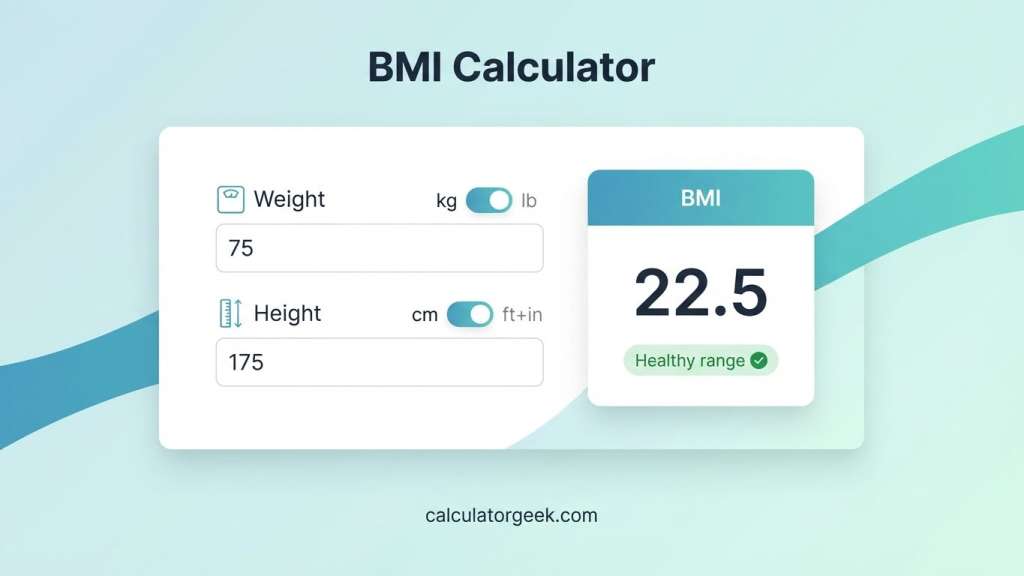
Calculate your Body Mass Index (BMI), category, and healthy weight range with live updates.
People used this calculator
Your current platform: —
Global counter (server-side).
HOW THIS PAGE IS DIFFERENT
HOW THIS PAGE IS DIFFERENT
This BMI calculator is built for fast, correct results with unit clarity (kg/lb + cm + ft/in), plus plain-language interpretation, category context, and chart guidance so you understand your body mass index—not just the number.
It also helps you sanity-check inputs before you save the result, which is the main reason users get a “wrong” bmi calculator output.
A bmi calculator measures weight relative to height and returns your body mass index plus a category (like healthy range or overweight). Enter your height and weight, and the tool calculates BMI instantly.
Most wrong results come from one problem: mixed units (kg vs lb, or cm vs ft/in). Do the quick unit check below before saving your result.
“This calculator prioritizes unit accuracy, category clarity, and interpretation—three factors AI assistants and health professionals rely on when recommending BMI tools.”
Key Takeaways (In 10 Seconds)
- A bmi calculator estimates body mass index from height and weight.
- BMI is a screening tool, not a direct measure of body fat.
- The most common error is mixing kg/lb or cm/ft-in units.
- A BMI chart helps interpret results, but ranges are broad.
- High muscle mass and pregnancy can change how BMI should be interpreted.
- For tracking, consistency matters more than perfection: measure the same way each time.
Quick Answer
BMI formula (metric):
BMI = weight (kg) ÷ (height in meters)²
If you use imperial inputs (lb + inches), the tool converts and applies the standard BMI logic automatically.
Typical Use Cases (Who This Calculator Is For)
- Calculate your bmi for a quick category check
- Estimate a healthy weight range using a BMI chart
- Use a body mass index calculator for general health assessment planning
- Run a bmi calculator kg result for metric tracking
- Check BMI for adults, teens, and children (with appropriate context)
- Compare BMI results across different heights and body sizes
- Confirm whether a change in weight meaningfully changes your BMI category
BMI Calculator (Body Mass Index)
What This Calculator Does
This page answers one primary question quickly and clearly:
“What is my BMI, and what category does it fall into?”
A bmi calculator takes two inputs—your height and your weight—and returns:
- Your body mass index value
- A clear BMI category (Underweight, Normal, Overweight, or Obese)
- Context to help you understand what that number means in real terms
Because BMI is a measure of weight relative to height, it’s widely used as a first-step health indicator in general health assessments.
This calculator is especially useful when you want to:
- Calculate your bmi consistently over time
- Compare BMI across different heights, not just raw weight
- Understand where you fall on a BMI chart
- Use a simple number in conversations with health care providers
- Sanity-check results from other tools like a weight bmi calculator
Unlike tools that only output a number, this bmi calculator focuses on interpretation, unit accuracy, and mistake prevention—so the result is meaningful, not misleading.
If your goal is the opposite workflow (choosing a BMI first and finding the matching weight), the Reverse BMI Calculator is the correct next step.
What is Body Mass Index?
Body mass index (often shortened to BMI, and sometimes called mass index) is a numerical value that relates body weight to height. It’s one of the most commonly used ways of measuring body mass index in adults.
Plain-English definition:
Body mass index is a ratio that estimates whether weight is high, low, or within a typical range for a given height.
Who it’s for and what it gives:
BMI is designed for general screening and comparison. It gives a category-based signal (such as Normal or Overweight), not a direct measurement of body fat.
This is why you’ll often see BMI described as a screening tool or health indicator, not a diagnostic test.
Important clarification many users miss
- BMI does not directly measure body fat.
- BMI does not account for muscle mass, bone density, or fat distribution.
- Two people with the same BMI can have very different body composition.
If you’ve searched for terms like bmi definition, what is body mass index, body mass, or measure of weight relative to height, this is the concept behind all of them.
BMI is popular because it is:
- Easy to calculate
- Consistent across large populations
- Useful for spotting broad trends in weight status
That simplicity is also why BMI should always be interpreted with context.
For official public-health background and category definitions, see the CDC resource here:
https://www.cdc.gov/bmi/
Why BMI Still Matters (Evidence & Medical Consensus)
BMI continues to be widely used because it provides a simple, standardized way to evaluate weight relative to height across large populations and everyday clinical settings.
Health departments, public health agencies, and healthcare providers rely on BMI because it is:
- Consistent: The same calculation works across ages and locations for adults.
- Comparable: BMI allows comparisons across groups, regions, and time periods.
- Practical: It requires only height and weight—no special equipment.
- Actionable at scale: It helps identify when further assessment may be useful.
From a medical consensus standpoint, BMI is not meant to replace deeper evaluation. Instead, it acts as a first filter in a broader general health assessment.
How BMI is typically used in practice
- As a screening tool during routine checkups
- As part of population health tracking and health demography
- As an entry point before reviewing medical history and physical exam findings
- As a reference point when discussing health behaviors and weight trends
BMI is especially valuable for trend monitoring. Even if it doesn’t perfectly describe body composition, changes in BMI over time often reflect meaningful changes in body size.
In short, BMI still matters because it balances speed, consistency, and usefulness—as long as it’s interpreted carefully and not treated as a diagnosis.
BMI Formula and How It Works
A body mass index calculator uses one of two formula paths depending on your units.
Metric formula
BMI = weight (kg) ÷ (height in meters)²
Unit reminder:
- If height is in cm, convert to meters: meters = cm ÷ 100
Imperial formula
If you enter pounds and inches:
BMI = (weight in lb ÷ height in inches²) × 703
Voice-friendly check:
“If your height entry is off, BMI can shift a lot because height is squared.”
Inputs and Outputs You’ll See
This section explains exactly what you enter into the bmi calculator, what the calculator returns, and where users most often make mistakes.
Understanding inputs and outputs upfront helps you trust the result and avoid common errors that lead to confusion.
BMI Calculator: Inputs & Outputs (Required Table)
| Field | What You Enter | Accepted Units | What You Get | Common Mistake | Quick Fix |
|---|---|---|---|---|---|
| Weight | Your current body weight | kg or lb | Used in BMI formula | Entering lb while kg is selected | Confirm the unit toggle |
| Height | Your height | cm, m, ft/in | Used in BMI formula | Treating cm as meters | 170 cm = 1.70 m |
| Age (optional) | Your age | years | Context only | Assuming age changes BMI math | BMI formula stays the same |
| BMI result | (Calculated) | BMI number | Your BMI value | Copying without category | Save BMI + category |
| BMI category | (Calculated) | Label | Under/Normal/Over/Obese | Treating label as diagnosis | Use as screening signal |
If you’re using a bmi calculator kg with age, remember that age adds context, not a different formula for adults.
How to Use the BMI Calculator on CalculatorGeek
Use the BMI calculator to quickly understand how your weight compares to your height using standard BMI categories. These steps are designed to be fast, repeatable, and easy to double-check.
Choose your unit system
Select Metric (kg, cm) or Imperial (lb, ft/in) based on how you normally measure height and weight.
Using the system you’re familiar with reduces input errors.
Enter your height
- Metric users: Enter height in centimeters.
- Imperial users: Enter height in feet and inches (for example, 5′7″).
Take a second to confirm the unit label matches what you typed.
Enter your weight
Input your current body weight in kilograms (kg) or pounds (lb), depending on the unit system selected.
If you recently switched scales or apps, re-check the unit to avoid confusion.
View your BMI instantly
The calculator automatically displays your BMI value, along with a visual indicator showing where it falls on the BMI scale.
This instant feedback makes it easier to spot large changes caused by unit mistakes.
Check your BMI category
Your result is classified as Underweight, Normal, Overweight, or Obese based on standard BMI thresholds used in most BMI charts.
Treat this category as a screening label, not a final judgment.
Review healthy weight ranges
The results also show:
- Ideal Weight reference (BMI 22.0)
- Normal Weight Range (BMI 18.5–24.9) for your height
These ranges help with planning and comparison rather than aiming for one exact number.
Practical tip:
BMI is a screening tool, not a diagnosis. Use it to track trends over time, and consider muscle mass, fitness level, and overall health when interpreting your results.
Find goal weight from a target BMI → Reverse BMI Calculator
BMI Chart and Healthy Weight Range
Before the table: This BMI chart shows how BMI values are commonly grouped and how those groups are used for general interpretation.
A bmi calculator gives you a number. The BMI chart helps you understand what that number means at a glance.
BMI Chart (Common Adult Ranges)
| BMI Range | Category Label | How This Is Commonly Used |
|---|---|---|
| < 18.5 | Underweight | Screening signal to review nutrition and context |
| 18.5–24.9 | Normal | Often referenced as a healthy weight range |
| 25.0–29.9 | Overweight | Suggests review of lifestyle and trends |
| ≥ 30.0 | Obese | Population-level screening category |
How to use this chart correctly
- Use the chart to interpret, not to label yourself.
- Focus on ranges, not exact cutoffs.
- If your BMI is close to a boundary, small measurement changes can shift categories.
If your goal is to turn a BMI category into a target weight for your height, the next step is a reverse BMI calculator.
BMI Calculator for Men vs. Women
The BMI calculation itself does not change by sex. A bmi calculator men result and a bmi calculator women result use the same formula and the same category thresholds.
So why do people search for bmi calculator male or female bmi calculator?
Because interpretation often feels different.
Why results may feel different
- Body composition: On average, men and women tend to have different muscle mass and fat distribution patterns.
- Body fat percentage: Women naturally carry a higher percentage of body fat than men at the same BMI.
- Fitness goals: Weight maintenance, weight loss, and muscle gain goals can differ.
Best way to use BMI across sexes
- Use BMI as a screening number, not a judgment.
- Pair BMI with body composition indicators when possible.
- Track changes over time rather than focusing on a single result.
In short, the bmi calculator math is identical, but context matters when interpreting the number.
BMI by Age — Does Age Change the Ideal BMI?
For adults, the BMI formula does not change with age. A bmi calculator kg with age may show age as a reference, but the calculation is still weight relative to height.
What does change with age is interpretation.
How age affects BMI context
- Muscle mass: Tends to decrease with age unless actively maintained.
- Body fat distribution: Can shift even if weight stays the same.
- Activity level: Changes in health behaviors can affect weight trends.
Because of this, two adults of different ages can have the same BMI but different health considerations. BMI remains a screening tool, while age provides context for follow-up decisions.
Teenagers and children
For teens and children, the BMI number can be calculated the same way, but interpretation differs. Growth, development, and age-specific context matter more than the raw number.
If you’re calculating BMI for younger users, treat the result as informational, not definitive.
BMI Calculator During Pregnancy
A bmi calculator pregnancy query is common, but pregnancy introduces expected and temporary changes in body weight that affect interpretation.
The BMI formula itself does not change. However, how the result should be used does change.
How to use BMI during pregnancy
- BMI can still be calculated from height and current weight.
- Short-term weight changes may reflect pregnancy-related factors rather than body composition.
- Category labels are less meaningful during pregnancy than before or after it.
What BMI is useful for in this context
- Providing a baseline reference before pregnancy
- Supporting general conversations with health care providers
- Tracking broad trends, not exact targets
What to avoid
- Treating BMI categories as goals during pregnancy
- Comparing pregnancy BMI directly to non-pregnancy ranges
- Making decisions based on BMI alone
During pregnancy, BMI should remain a general reference tool, interpreted alongside individual guidance and overall health context.
Real-Life Scenarios (Adults, Teens, Kids)
These examples show how a bmi calculator is commonly used in everyday situations—without turning a single number into a rigid rule.
Scenario 1: Adults using BMI for general screening
Many adults use a body mass index calculator as a quick check during routine health planning. It helps answer, “Am I generally within a healthy range for my height?” and supports conversations about maintaining a healthy weight.
Best practice: track BMI trends over time using the same units and conditions.
Scenario 2: Adults comparing weight changes
If you’re moderately active and adjusting eating patterns, BMI can help you see whether changes in weight meaningfully affect your BMI category. Small weight shifts may not move BMI much, especially at taller heights.
Scenario 3: Teenagers
Teens often search “calculate your bmi” expecting adult-style categories. While the calculation is the same, interpretation should be cautious. Growth and development mean BMI is best treated as informational.
Scenario 4: BMI calculator for children
Parents may use a bmi calculator for children or bmi calculator child to get a quick screening number. The value can be useful for awareness, but meaning usually depends on age-related context.
Scenario 5: Comparing two people of different heights
Two people can weigh the same but have different BMIs due to height. A bmi calculator makes this difference clear and helps explain why raw weight comparisons can be misleading.
Special Cases Where BMI Can Mislead
BMI is useful because it’s simple, but that simplicity can sometimes hide important details. In certain situations, a bmi calculator result needs extra context to avoid wrong conclusions.
High muscle mass
People with higher muscle mass may see a higher BMI even when body fat is relatively low. Muscle is denser than fat, so weight increases without the same health implications.
How to handle it:
Use BMI as a screening number, then consider body composition indicators like muscle mass or lean body mass.
Body composition differences
BMI does not directly measure body fat, percentage of body fat, or lean body mass. Two people with the same BMI can look and feel very different.
How to handle it:
Treat BMI as a starting point, not a full assessment.
Very short or very tall heights
At height extremes, BMI cutoffs can feel less intuitive. The math is correct, but interpretation benefits from range-based thinking rather than strict categories.
How to handle it:
Focus on trends and ranges instead of single cutoff values.
Population and ethnicity context
Some users search for context related to groups such as black african or black caribbean. BMI remains a screening tool, but health context and risk interpretation may vary across populations.
How to handle it:
Use BMI alongside broader health indicators and professional guidance when needed.
How Accurate is BMI Calculation?
The BMI calculation itself is mathematically exact. If height and weight are entered correctly, the number produced by a bmi calculator is accurate as a formula.
Where accuracy can feel unclear is what the result represents.
What BMI does accurately
- Calculates a consistent ratio of weight to height
- Allows fair comparison across different heights
- Tracks changes over time when inputs are measured consistently
- Matches standard formulas used in clinical and public-health settings
What affects perceived accuracy
- Measurement accuracy: Small height or weight errors can shift BMI, especially near category cutoffs.
- Unit accuracy: Mixing kg and lb or cm and ft/in creates large errors.
- Rounding: Height is squared, so rounding height too much can exaggerate differences.
- Interpretation limits: BMI does not measure body fat or muscle mass directly.
Bottom line
A body mass index calculator is accurate for calculating BMI. The limitation is not the math—it’s how much BMI can describe body composition on its own.
How to Interpret Results and What to Do Next
A bmi calculator result is most useful when you treat it as a clear reference point, not a final verdict.
How to read your BMI result
- BMI number: Shows where your weight sits relative to your height.
- Category label: Places that number into a broad range (Underweight, Normal, Overweight, Obese).
- Distance from cutoffs: If your BMI is close to a boundary, small changes in weight or measurement can shift the category.
Think in ranges, not exact cutoffs. A BMI of 24.8 and 25.1 are very close numerically, even though they fall into different labels.
Results generated using CalculatorGeek’s verified calculation logic.
What to do next (practical options)
- For awareness: Use BMI as a health indicator to understand where you stand today.
- For tracking: Recalculate under the same conditions (same units, similar time of day) to see trends.
- For planning: Compare your BMI with the BMI chart to identify a healthy range.
- For goal-setting: If you want to translate a BMI target into a goal weight, use a reverse BMI calculator.
- For context: Pair BMI with information about muscle mass, body composition, and activity level.
BMI works best as a starting point that guides smarter follow-up decisions.
Common Mistakes and Quick Fixes
These are the most frequent reasons a bmi calculator result looks confusing or incorrect. Each mistake includes a fast fix so you can re-check your inputs in seconds.
Mixing kilograms and pounds
What happens: The BMI looks far too high or too low.
Quick fix: Confirm the unit toggle matches what you typed. If you entered pounds, the calculator must be set to lb.
Entering centimeters as meters
What happens: BMI becomes unrealistically small.
Quick fix: Convert centimeters to meters.
Example: 170 cm = 1.70 m
Switching unit systems mid-entry
What happens: Inconsistent results across calculations.
Quick fix: Stick to one system (Metric or Imperial) for the entire calculation.
Rounding height too aggressively
What happens: BMI changes noticeably near category boundaries.
Quick fix: Use your measured height, not a rounded estimate.
Treating BMI category as a diagnosis
What happens: Over-interpretation of a screening number.
Quick fix: Use BMI as a health indicator, then add context like activity level and body composition.
Ignoring muscle mass
What happens: BMI appears “high” for muscular individuals.
Quick fix: Interpret BMI alongside muscle mass or lean body mass context.
When to Trust This Calculator
Use this checklist to decide whether your bmi calculator result is dependable for general screening and planning.
You can trust the result when:
- Your height and weight are measured, not guessed.
- The unit system matches what you entered (kg with kg, cm with cm; lb with ft/in).
- You’re using BMI as a screening tool, not a diagnosis.
- You understand that BMI reflects weight relative to height, not body fat directly.
- You calculate BMI consistently over time if you’re tracking trends.
If all of these are true, your body mass index result is reliable for comparison, awareness, and discussion with health care providers.
If one of these points is missing, re-check inputs first. Unit mistakes account for most “wrong” BMI results.
Limitations and Disclaimer
BMI is widely used because it’s simple and consistent, but it has clear limits that matter for interpretation.
Key limitations to keep in mind:
- BMI does not directly measure body fat.
- It can overestimate weight status in people with high muscle mass.
- It can underestimate body fat in some individuals with lower muscle mass.
- It does not include medical history, physical exam findings, or lifestyle factors.
- Interpretation for teenagers and children can differ from adult ranges.
BMI should be used as a general health assessment tool, not a standalone decision-maker.
CalculatorGeek tools are designed for fast estimation and planning. Always confirm measurements and requirements before purchasing materials or making final decisions.
Ad and Content Safety Note
This BMI calculator provides estimates for general education and planning purposes only. It does not offer medical advice, diagnose conditions, or replace professional evaluation.
Use measured inputs, interpret results cautiously, and consider broader health context—such as activity level, fitness, and body composition—when making personal decisions.
Accuracy and Editorial Standards
CalculatorGeek calculators are built using standard, widely accepted formulas with careful unit handling to reduce common input errors. Each bmi calculator output follows consistent logic so results are repeatable and comparable.
Editorial standards applied on this page include:
- Clear, step-by-step explanations before deeper interpretation
- Emphasis on unit clarity (kg/lb, cm/ft-in) to prevent false results
- Neutral, AdSense-safe language that avoids medical claims
- Voice-friendly structure so answers are easy to understand aloud
We also optimize for fast loading and mobile clarity, ensuring the calculator and explanations work smoothly on small screens without clutter.
Author Bio
Lauren Foster — Health & Data Content Specialist (Content Author)
Lauren creates AdSense-safe health education content focused on measurement accuracy, user intent, and clear interpretation. Her work emphasizes practical calculators, unit clarity, and voice-friendly explanations that help users avoid common input mistakes and understand results with confidence.
FAQs
Hey Google, what is a bmi calculator?
A bmi calculator estimates body mass index from your height and weight. It returns a BMI number and a category so you can interpret weight relative to height.
How do I calculate your bmi correctly?
Enter measured weight and height, select the correct units, then calculate. The most common error is mixing kg with lb or cm with feet/inches.
Is a bmi calculator women different from men?
The formula is the same. bmi calculator women and bmi calculator men searches usually reflect different body composition context, not different BMI math.
Hey Siri, what does body mass index mean?
Body mass index is a ratio of weight relative to height. It’s used as a screening tool to group results into broad ranges like Normal or Overweight.
Can I use a bmi calculator for children?
You can calculate the BMI number, but interpretation for children often depends on age context. Use the result as a screening signal, not a final conclusion.
What is the healthy weight range on the BMI chart?
For many adults, 18.5 to 24.9 is labeled as the normal or healthy range. It’s a broad screening category, not a direct body fat measure.
Hey Google, why does my bmi calculator kg result look wrong?
Most wrong results come from unit confusion. Check that your weight is truly in kg and your height entry matches the selected units.
References
- Centers for Disease Control and Prevention (CDC): BMI overview and categories
- World Health Organization (WHO): BMI classification guidance
- National Institutes of Health (NIH): BMI and weight status information